Archive for Edinburgh Fringe 2026

1518: The Dancing Plague — Satire, Chaos and Queer Heart at the Fringe

Click on image to buy tickets

★★★★★There’s something deliciously Fringe about a show that invites you to “shake your a** and dance ’til you (hopefully don’t!) die,” and 1518: The Dancing Plague leans into that promise with full satirical commitment. Based on the very real medieval mass hysteria that had Strasbourg’s citizens dancing themselves into oblivion, Hannah Ponturo’s comedy arrives at theSpaceUK fresh from Los Angeles—armed with a sold‑out reading, a Daredevil Festival pedigree, and the kind of chaotic energy that thrives in late‑night Edinburgh.

At its heart is a queer romance between Katherine and Anna, two peasants whose long‑fractured relationship reignites just as the city collapses around them. It’s a smart dramatic anchor: while clergy and civic authorities scramble to contain the outbreak, the play keeps circling back to the human impulse to connect even when the world is wobbling off its axis. The production promised “uncanny parallels” to our own recent crises, and the show doesn’t shy away from them—Covid echoes, political absurdity, and the familiar spectacle of institutions panicking while ordinary people try to make sense of the mess.
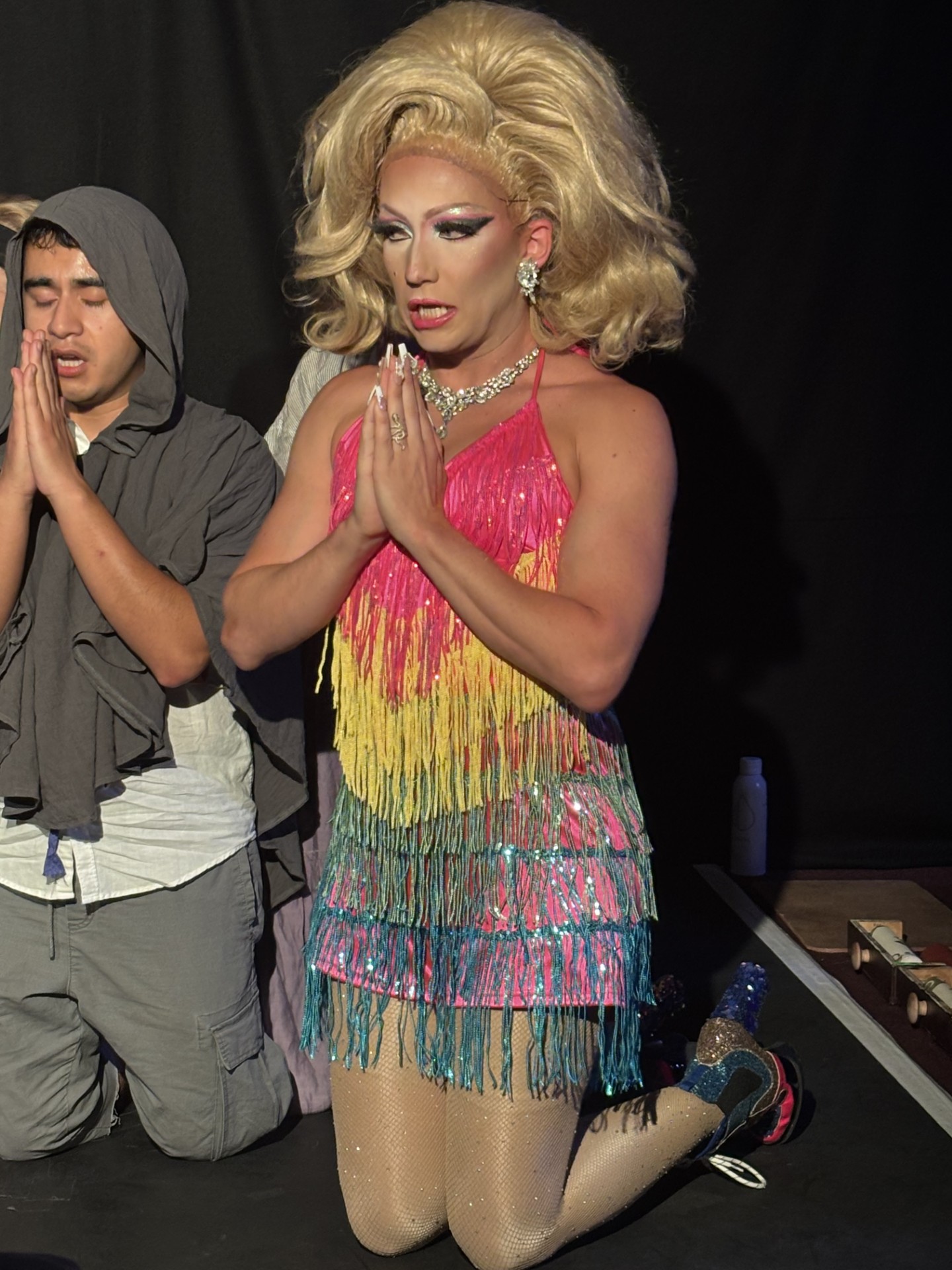
We loved the drag devil/angel narrator

Ponturo’s writing has that LA‑meets‑NYC flavour: punchy, self‑aware, and unafraid of silliness as a delivery system for something sharper. The production, created with Open Variations Theater, fits neatly into their mission of reimagining lesser‑known stories with contemporary bite. You can feel the interdisciplinary New York influence in the way the piece layers satire, history, and outright party vibes into a single 50‑minute burst.

And yes, it is a dance party. The show wants you complicit in the hysteria—laughing at it, recognising it, maybe even feeling the tug of it. The absurdity of people dancing themselves to death becomes a mirror held up to the way we cope with uncertainty now: distraction as survival, movement as denial, rhythm as rebellion.

It’s messy, cheeky, knowingly ridiculous, and unexpectedly tender. Exactly the sort of Fringe show that sneaks up on you: you arrive for the chaos, and leave thinking about the systems that shape how we behave when everything goes sideways.

If you’re looking for a satire with historical weirdness, queer heart, and a healthy disrespect for authority, 1518: The Dancing Plague earns its place on your August shortlist.

Reviewed by Pat Harrington

Click here for tickets

Leave a Comment

Body Parts: A Simple, Human Story of Repairing What’s Broken

Click on image to buy tickets

★★★★★  Body Parts is a small, honest, and quietly powerful Fringe show about a family trying to rebuild itself after a loss. A mother travels to rural Scotland, alongside one daughter, to visit another daughter who has bought a rundown house with her inheritance. The house is falling apart, and so are the relationships inside it. That’s the heart of the piece: people trying to fix things when they’re not sure how.

The story centres on four characters who are all dealing with their own turning points. Carmel is determined to make a fresh start, even if the house she’s chosen is barely standing. Margot tries to support her, though she sees the cracks clearly. Russell, Carmel’s on‑off boyfriend, is stuck between wanting to help and not knowing where he fits. And May, the mother, watches all of this with a mixture of worry, affection, and a growing sense of her own needs.

One of the strongest parts of the show is how it handles self‑acceptance. There’s a moment where May asks to be photographed so she can draw herself honestly. It’s simple, but it says a lot about how she’s trying to see herself again after years of putting everyone else first. Her relationship with her daughters also has real depth, especially with Margot, who has converted to Islam. It’s treated with respect and adds an additional, natural cultural layer to the family dynamic.

The show also uses physical theatre in a way that feels grounded rather than gimmicky. A scene where the women crawl across the floor stands out — it’s a clear picture of how stuck they all are, and how hard they’re trying to move forward.

The writing feels real. You can tell it’s been shaped by personal experience. The conversations sound like things families actually say when they’re tired, frustrated, or trying their best. The show asks a good question: what do you need when you’ve run out of wanting? It doesn’t force an answer, but it gives you plenty to think about.

There’s also some clever use of technology — facial‑mapping, sound, and projection — but it never takes over. It supports the story rather than showing off. That’s rare at the Fringe, and it’s done well here.

The cast work strongly as an ensemble. They play the tensions and the small moments of connection with a natural ease. Nothing feels exaggerated or over‑acted.

Body Parts is a thoughtful, well‑performed piece about ageing, faith, self‑worth, and the messy ways families try to support each other. It’s simple, human, and quietly moving. And it leaves you wanting to see what this writer does next.

Reviewed by Pat Harrington

Click here for tickets


Leave a Comment

A Family Trade, a National Debate: Pierrepoint’s Life Condensed into One Hour of Compelling Theatre

Click on image to buy tickets

★★★★ Albert Pierrepoint remains one of the most unsettling yet compelling figures in British criminal history, and Pierrepoint: The People’s Hangman approaches him with a seriousness that suits the subject. Rather than sensationalising his work or turning him into a caricature of grim authority, Andrew Hogarth attempts something far more ambitious: it invites us to see the world through the executioner’s eyes.

Pierrepoint served as Britain’s principal hangman for roughly twenty‑five years, executing an estimated 435 people between the 1930s and 1950s. His career intersected with some of the most notorious murderers of the era — John Haigh, the Acid Bath Killer; Ruth Ellis, the last woman hanged in Britain; and John Reginald Christie of 10 Rillington Place, whose crimes form the backbone of this production.

The show’s strongest material lies in its treatment of Christie. Rather than presenting him simply as a monster, the production dissects his crimes with forensic clarity, exploring not only what he did but how he came to be standing on Pierrepoint’s trapdoor. Christie’s murders — committed in the suffocating confines of 10 Rillington Place — are examined with a clinical, unsettling intimacy. We see the bureaucratic machinery of justice grinding forward, and Pierrepoint positioned at its final, irreversible stage.

Professionalism, Precision, and a Missing Piece

One of the most compelling aspects of Pierrepoint’s life — and something the production hints at but never fully explores — is his almost mathematical approach to execution. He believed deeply in the dignity of his work and the necessity of performing it with precision.

Pierrepoint openly criticised the Americans for their botched hangings of Nazi war criminals after the Nuremberg trials. In his autobiography, he described their methods as clumsy, miscalculated, and needlessly cruel, with several condemned men taking far too long to die because the drop lengths were wrong.

This detail is not included in the production, but it would have enriched it enormously. It illustrates Pierrepoint’s broader philosophy: if the state is to take a life, it must do so swiftly, cleanly, and without unnecessary suffering. Including this would have given audiences a clear example of his professional ethos.

A Family Business

One of the surprises in the show — and a detail that many will not know — is that Pierrepoint came from a long line of executioners. His father Henry began in 1901, his uncle Thomas in 1906, and Albert himself took up the role in September 1932. This wasn’t a macabre calling; it was, in a very real sense, the family trade. The production handles this well, and it adds a fascinating layer to Pierrepoint’s character: he was stepping into a legacy as much as he was taking on a job.

The Challenge of a One‑Hour Biography

This is where the production struggles. A one‑hour Fringe slot is a notoriously tight container for a life as complex as Pierrepoint’s. Choices must be made about what to include and what to sacrifice. Here, the balance tilts too heavily toward the criminals he executed — Christie in particular — at the expense of exploring Pierrepoint’s own motivations, philosophies, and contradictions.

The result is a show that is fascinating, but not fully balanced. The narrative structure is clear, but the weighting of material feels slightly off. Pierrepoint’s inner world, his moral evolution, and his reflections on capital punishment deserve more space. That imbalance is the reason this review lands at four stars rather than five. The script simply needs fine‑tuning.

Potential, Audience Appetite, and the Ongoing Debate

The Fringe is the perfect environment for a show like this. Productions can evolve rapidly in response to audience and critical feedback, and this one has all the ingredients to become a truly exceptional piece. With some structural refinement, it could easily reach five‑star territory.

There is also a substantial audience for this kind of work. True crime has become a cultural phenomenon; dramatizations of cases like Ruth Ellis continue to draw viewers decades later. Pierrepoint himself is strangely under‑examined in modern media, despite his central role in some of the most infamous cases of the 20th century.

And, of course, the debate around capital punishment is far from settled. Today, support for the death penalty often comes not from belief in deterrence but from a visceral desire for retribution, particularly in cases involving children. The show touches on this, but could go further — and doing so would deepen its relevance.

Verdict

Pierrepoint: The People’s Hangman is a thought‑provoking, tightly performed, and quietly unsettling piece of theatre. It neither glorifies nor condemns Pierrepoint; instead, it presents the contradictions and lets them breathe. With a more balanced script — one that gives equal weight to the man and the crimes that defined his career — this could become one of the standout productions of the Fringe.

For now, it is a strong four‑star show, rich with potential and already one of the most intriguing pieces of the year.

Reviewed by Pat Harrington
Click here for tickets


Leave a Comment

Counter Culture Podcast: Music Icons On Stage At The Edinburgh Fringe

Pip: Counter Culture has been sending dispatches from the Edinburgh Fringe, and the dispatches all point in the same direction: toward stages where pop mythology gets a second life.

Mara: Patrick Harrington covers a run of Night Owl Shows productions this week — icons under the spotlight, trailblazing women of rock, and the question of what it actually means to honour a musical legend rather than just impersonate one. Let’s start with reinvention, and the artists who made it an art form.

Pop Legends And Reinvention

Mara: The thread running through these Fringe productions is a single question: how do you tell a story that’s already been told a thousand times without flattening it into a greatest-hits playlist?

Pip: The Bowie Story review puts its cards on the table early, describing a show that “chooses interpretation over imitation, and is all the better for it.”

Mara: That distinction carries real weight. Imitation gives you the surface — the accent, the costume. Interpretation gives you a reason to be in the room.

Pip: And the review is honest about where the show stops short. There’s a wish for more on Bowie’s challenge to gender norms — communities for whom he wasn’t decoration but a lifeline. That’s a meaningful gap in sixty minutes.

Mara: The interview with Peter Marchant fills some of that in. He talks about Ziggy’s androgyny directly, and describes what those lyrics must have meant: “Hearing lyrics like ‘you got your mother in a whirl, she can’t tell if you’re a boy or a girl’ must have been very liberating and validating for queer people to hear for the first time.”

Pip: A sequin lightning bolt jacket and a lot of, quote, ass shaking are apparently also part of the methodology.

Mara: He’s clear that embodying Bowie’s queerness isn’t just costuming — it’s in how he moves, how he shapes each persona’s vocal register, how the band reflects the production shifts across albums.

Mara: The Madonna review, Material Girl: Madonna The Icon, picks up the same thread from a different angle. There’s a moment where a quote appears on screen — Madonna rejecting the word “reinvention,” insisting she reveals layers rather than constructs new selves.

Pip: Which quietly reframes the Bowie conversation too. Maybe every persona was an excavation, not a costume change.

Mara: And then Dancing Queen: An ABBA Tribute lands as the third piece of this argument. The review notes ABBA’s real genius was “their ability to smuggle heartbreak into songs that sounded like celebrations” — outsiders who rewired pop from the inside.

Pip: Three productions, one through-line: the artists who lasted weren’t shapeshifters. They were just unusually honest about having more than one shape.

Mara: That honesty is what these shows are trying to transmit — and it’s also what separates them from a standard tribute night. Speaking of artists with more than one shape, the Fringe also had a stage full of women who built rock from the ground up.

Soulful Voices And Trailblazers

Pip: Women of Rock opens with Sister Rosetta Tharpe, which is exactly the right place to start if you want to make a point about who actually invented what.

Mara: Tharpe said it herself: “Oh, these kids and rock and roll, it’s just sped up rhythm and blues. I’ve been doing that forever.” Chuck Berry and Elvis learned from her. The show knows that, and leads with it.

Pip: Crediting the source material — genuinely radical for a genre that spent decades pretending it had no mothers.

Mara: Back to Black: The Story of Amy Winehouse runs alongside Women of Rock as a companion piece, with Reine Beau performing both. The review makes the case that what she gets right is phrasing — “that slightly behind-the-beat looseness that Amy borrowed from Billie Holiday and Dinah Washington.” It’s the detail that separates understanding from copying.

Pip: Two shows a night, emotionally heavy material, and the review says her energy never dips. That’s the real tribute.

Mara: Both productions sit inside the same argument: these voices deserve more than nostalgia. They deserve the full story.


Pip: Interpretation over imitation, layers over reinvention, heartbreak inside the celebration — the Fringe keeps asking what it means to honour someone, and these shows keep finding different answers.

Mara: Next time, we’ll see what other territory Counter Culture has been mapping. There’s always more ground.

Leave a Comment

Celtic Folk with Heart: Skyrie’s Songs and Stories Captivate

★★★★★ Some Fringe venues feel like they’re trying to be something they’re not. The Ukrainian Community Centre isn’t one of them. Its main room — cosy, lived‑in, almost like stepping into someone’s front room — turns out to be the perfect setting for Celtic folk. The atmosphere wraps around you before the music even begins, and when Skyrie take the stage, the space feels made for them.

Formed in 2015 by Lesley Thompson Smith and Christopher Martin Smith, with James “Jimmy” Anderson joining in 2020, Skyrie have built a reputation for blending Scottish and Irish traditional tunes with their own original compositions. Their albums Ceilidh – Celi (2023) and Hunger Road (2024) show a band rooted in tradition but unafraid to push into new territory.

What stands out immediately is how accomplished they are as instrumentalists. Lesley, a multi‑instrumentalist and composer, moves between fiddle, whistle, pipes and mandolin with ease. She’s competed three times in the Glenfiddich fiddle competitions — a detail that tells you everything about her calibre — yet she speaks to the audience with warmth and humour, introducing her fiddle “Smillie” as though it were an old friend. Hearing her play her own “Smillie” composition is a highlight: tender, expressive, and full of character.

Her stories add a lovely intimacy to the evening. She talks about fiddle retreats in Inverness, all‑day sessions, late‑night concerts, and how those experiences inspired her composition “Beauty Sleep.” Another touching moment comes when she introduces “Come Back Home,” written when her children left home. These personal threads give the performance emotional depth without ever feeling sentimental.

Jimmy Anderson brings a steady, confident presence on guitar, and the fact he has toured with Shirley Manson adds a quiet prestige to the trio. Christopher Martin Smith, meanwhile, anchors the rhythm on bodhran and percussion. His background as a session drummer with Big Country shows in his precision, but it’s his storytelling that wins the room. The audience love hearing that his bodhran is made of goat skin, and his tale of writing “Take Me Home With You” — a song about two middle‑aged people meeting as the bar closes — is delivered with a charming self‑deprecating grin.

One of the most memorable moments of the night comes when the band talk about performing in Colorado in 2024. Their story of a four‑wheeler ending up in a ditch at Black Canyon of the Gunnison National Park is told with such good humour that the audience is already laughing before the song begins. “Jimmy’s Ditch,” performed with Lesley on fiddle, Jimmy on guitar and Christopher on bodhran, is beautiful — lively, melodic, and clearly a favourite with the crowd.

Skyrie are one of those rare Fringe acts that feel both polished and deeply personal. Their musicianship is exceptional, their rapport with the audience effortless, and their storytelling adds richness to every tune. This is Celtic folk at its most heartfelt: rooted in tradition, shaped by lived experience, and delivered with genuine joy.

It’s one of the most uplifting music events of the Fringe, and absolutely not to be missed. Listen to their music, buy their albums, and if you’re in North Carolina later this year, catch them at the Raleigh Wide Open Festival on 3rd October or at the Scottish Society of Wilmington on 4th October.

Reviewed by Jacqueline Sharp


Leave a Comment

A Soul Tribute with Heartfelt Enthusiasm and Room to Grow

★★★★ Divas of Soul arrives at the Fringe with a strong pedigree. Last year, this young band earned four‑star reviews for Divas of Jazz, praised for “mesmerising vocals” and a late‑night atmosphere that clearly resonated with audiences. Their new show is more ambitious: a journey through six decades of soul, tracing the genre’s evolution through its greatest voices — Aretha Franklin, Otis Redding, Roberta Flack, Randy Crawford, Stevie Wonder, Amy Winehouse, Olivia Dean and more.

From the first groove, Theatre 1 fills with warm, confident musicianship. The band are tight, stylish, and clearly in love with this music. Pianist Angus Alphonse and drummer Vic Palmer lock into rhythms with ease, while Joey Read’s bass gives the set its pocket and pulse. They’re a well‑matched ensemble, and when they settle into a rhythm, the room lifts.

A real strength of the show lies in its storytelling. Vocalist Hannah Hay guides the audience through the history of soul — its origins, its cultural weight, the artists who shaped it — and these spoken passages are engaging and well delivered. The show promises that each song arrives with the story behind it, and that intention comes through clearly. Her enthusiasm for the genre is unmistakable, and the educational thread gives the evening a welcome sense of shape and purpose.

Vocally, the performance sits in a different space. Hay’s jazz‑trained voice, the same one that earned praise last year, leans toward a cleaner, more polished tone rather than the raw, gritty texture soul typically demands. When covering Amy Winehouse and other artists she cites as inspirations, the hallmarks of soul — note bending, micro‑tonal shifts, that lived‑in rasp — don’t fully appear. Her voice is pleasant and capable, but stylistically it doesn’t always land where the material needs it to.

This creates a slight mismatch: the band deliver authentic soul grooves, while the vocals steer toward a more polished, event‑band sound. It doesn’t make the performance bad — far from it — but it does mean the show feels more like a lively, well‑played late‑night Fringe wind‑down than a fully realised soul tribute.

Still, there is plenty to enjoy: excellent musicians, a singer who genuinely loves the genre, and a thoughtful narrative thread that enriches the experience. The ambition behind Divas of Soul is clear, and with deeper stylistic commitment on the vocal side, it could evolve into something far more powerful.

Reviewd by Jacqueline Sharp


Leave a Comment

Three Kingdoms, Three Languages, One Captivating Musical Homage

★★★★ The Sanctuary at the New Town Church is one of those rooms that seems to breathe with you the moment you step inside. Circular, warm, and architecturally striking, it’s the kind of space that flatters a mezzo-soprano before she’s even sung a note. As the audience settled, the room’s natural resonance promised an evening shaped by history, language, and the long shadow of Mary Stuart.

This concert, led by Norwegian mezzo-soprano Marianne Beate Kielland with Ben‑San Lau at the piano, set out to honour not one anniversary but two: the 440th year since Mary Queen of Scots became Queen of Three Kingdoms, and the 400th anniversary of composer John Dowland. It’s an ambitious pairing—royal tragedy and Renaissance melancholy—and the programme moved between France, Scotland and England, with Marianne singing in all three languages.

Kielland is no stranger to major stages. Her career spans Europe, America and Japan, and she has appeared in operas from Moscow to Paris to Versailles. That experience shows. Her voice carries a calm authority, the kind that doesn’t need to announce itself. She moves through French repertoire with ease, letting the phrasing unfurl gently, and when she shifts into Scots or English, the tone darkens slightly, as though she’s adjusting the emotional temperature of the room.

The evening unfolded like a platter of songs—carefully chosen, beautifully delivered—but at times a little opaque. Most pieces were sung in French, and while the leaflet provided a set list, it offered no guidance beyond titles. Without spoken introductions, it became difficult to track where we were in the journey. A few words from Marianne—about her connection to the material, her love of mezzo repertoire, or even a brief nod to Mary Stuart’s turbulent life—would have added welcome texture. Her singing was expressive, but the silence between songs created a distance that didn’t need to be there.

Still, when the music was allowed to speak, it did so with clarity. Lau’s piano playing was sensitive and unobtrusive, shaping the atmosphere without ever overshadowing the voice. Together they created moments of real stillness, the kind that make an audience lean forward rather than sit back.

This concert was, in many ways, a tribute to lineage—musical, historical, and linguistic. It honoured Mary Queen of Scots not through storytelling but through sound, through the languages she lived in and the cultures she moved between. A little more communication from the stage would have deepened the experience, but the artistry itself was undeniable.

Reviewed by Jacqueline Sharp


Leave a Comment

Blues, Banter and Bold Whisky Choices Drive a Standout Fringe Experience

Click on image to buy tickets

★★★★★  Some Fringe shows promise a lot and deliver very little. Two Guys, 3 Drams does the opposite: it promises whisky and blues, and somehow delivers whisky, blues, comedy, education, and a roomful of people having a noticeably better time than they expected. After three consecutive sell‑out years, the show returns with the same swagger the performers boast about — “whisky‑soaked swagger, raucous blues, and boisterous charm”  — and the marketing isn’t exaggerating.

Felipe Schrieberg (vocals, lap steel) and Paul Archibald (drums, percussion, and that wonderfully unfashionable washboard) run the hour with the confidence of performers who know exactly what they’re doing. The performers call it “a sensory spectacle blending a world‑class whisky tasting with foot‑stomping live music”, and that’s precisely how it feels in the room: part gig, part tasting, part double‑act.

TheSpace @ Triplex was packed and buzzing throughout.


Music

The musical choices are strong throughout. Their take on I Put a Spell on You was the standout for me — gritty, tight, and delivered with enough bite to make the dram in your hand feel even more appropriate. Other numbers were less familiar, but the quality of the playing meant it didn’t matter. Felipe’s lap‑steel tone is rich and expressive; Paul’s rhythmic precision (especially on the washboard) is a rare treat.

Whisky

The whisky side is handled with a jokey, informal touch that makes the information stick. Felipe and Paul emphasise that the show is “as much about education as it is about entertainment” , and that’s true — but crucially, it never feels like a lecture. Audience questions, quick-fire facts, and a steady stream of banter keep things lively.

The drams on our night:

  • InchDairnie Rylaw Scottish Rye – easily the highlight. Smooth, distinctive, and surprisingly accessible. InchDairnie are a main sponsor this year, and their Head of Innovation calls the partnership “a brilliant way to bring whisky and music together”. Fair enough — the whisky is excellent.
  • A Singaporean whisky (whose name I missed) – light, balanced, and a pleasant surprise.
  • Laphroaig 15-year-old – the marmite dram. I’m firmly in the “no thanks” camp: too peaty, too medicinal, too smoky. Interesting, though, given it was my mother’s favourite whisky; she drank no other. Taste is a funny thing.

The chemistry between Felipe and Paul is the engine of the show. Years of playing together have given them an easy rapport, and the humour feels natural rather than rehearsed. The room was fully involved — responding to prompts, shouting back answers, and generally behaving like a Fringe audience who’ve decided they’re part of the act.

The performers promise you’ll “leave knowing how to sound clever about whisky for the rest of your life”. That’s not far off. You walk out with three good drams inside you, a handful of genuinely useful whisky facts, and the pleasant buzz of having spent an hour with performers who clearly enjoy what they do.

Warm, funny, informative, and musically accomplished. If you want a Fringe show that teaches you something without ever feeling like a lecture — and gives you three quality whiskies in the process — Two Guys, 3 Drams is an easy recommendation.

Reviewed by Pat Harrington

Click here to buy tickets

Leave a Comment

Nude Confronts the Male Gaze with Wit, Rawness, and Feminist Bite

Click on image to buy ticket

⭐⭐⭐⭐⭐ In this cleverly crafted piece, Nude dives headfirst into the complexities of the male gaze, nodding to Mulvey’s old‑school film theory but making it feel fresh, lived‑in, and painfully personal. Clara’s plan — to walk into a life‑drawing class and strip naked in front of her favourite lecturer — is introduced with a wickedly funny line: “No, but how funny would it be though? Like, he turns up, and it’s just me – with my tits out. His model student.”. It’s a moment that perfectly captures the show’s tone: bold, cheeky, and already teetering on the edge of something darker.

The male gaze — and why it matters here

Laura Mulvey’s theory of the male gaze argues that mainstream visual culture positions men as active lookers and women as passive objects of looking. Women become “to‑be‑looked‑at,” their bodies framed for male pleasure, validation, and control. What makes Nude compelling is that it doesn’t just critique this structure — it shows a woman actively stepping into it.

Clara doesn’t simply endure the male gaze; she seeks it, fantasises about it, and tries to choreograph it. She wants to be seen by her tutor in a way that makes her feel chosen, special, exceptional. That desire — to be looked at on one’s own terms — is the emotional engine of the show. It’s exactly what the press release calls “the seductive idea that being seen is the same as being empowered” . Clara confuses visibility with agency, attention with autonomy, and the play exposes how fragile that fantasy is.

This is where Nude becomes a genuinely contemporary feminist work. Mulvey’s theory was about cinema, but Clara’s story shows how the gaze operates in real life: women internalise it, negotiate with it, and sometimes chase it. The show asks a sharper question than most: why do we sometimes seek the very gaze that limits us?

Performance, writing, and Bacchanalia’s mission

Hattie Chapman

Hattie Chapman’s performance is the engine of the piece — restless, funny, and emotionally raw. Audience feedback from the Norwich Theatre R&D sharing described the work as “bold, lyrical, profound writing and superb performance” and “so real and raw” , which is exactly what Chapman delivers. She gives Clara a searching, self‑mythologising energy that makes the humour land and the emotional turns sting.

Phoebe Segal’s writing is confident and unafraid to push Clara into uncomfortable territory. Developed through Menagerie Theatre Company’s Young Writers’ Workshop and supported by Norwich Theatre and Frozen Light, the play has the feel of a young writer testing the edges of a big idea — and succeeding. Bacchanalia, the new East Anglian company founded by Segal and Merlyn Haycraft, frames its mission around interrogating inherited myths, “from ancient archetypes to cultural norms” , and Nude fits that remit perfectly. It takes the archetype of the woman on display and cracks it open from the inside.

A Fringe debut with bite

Nude begins with a joke and ends with a jolt, tracing Clara’s journey from playful self‑display to the moment her fantasy stops protecting  or trapping her. Chapman’s performance makes that turn land with real force, and Segal’s writing never shies away from the contradictions at its core. It’s a debut that not only showcases a formidable new talent but also embodies Bacchanalia’s mission to crack open the myths we inherit. A bold, unsettling, and memorable Fringe offering.

By Pat Harrington

Click here to buy ticket


Leave a Comment

From Eurovision to Global Icons: ABBA’s Story Reborn on Stage

Click on image to buy tickets

★★★★★  Night Owl Shows’ world‑premiere production traces ABBA’s rise from Eurovision outsiders to global pop architects, blending sharp live musicianship with narrative insight to reveal the emotional depth, innovation and lasting cultural impact behind the band’s greatest songs. Dancing Queen: An ABBA Tribute doesn’t just replay the hits; it reconstructs the story behind them — the improbable rise of four Swedes who turned melody, melancholy and sheer pop craftsmanship into global cultural currency.

Night Owl Shows have spent the past decade refining a particular Fringe formula: live musicianship, narrative clarity, and a respect for the material that goes beyond nostalgia. Their reputation — sell‑out runs, critical acclaim, and awards from Brighton to Adelaide — is well earned. But this new production feels like a step forward. It’s not just a celebration; it’s a piece of musical storytelling with genuine shape.

The show starts with ABBA’s Eurovision triumph with Waterloo, and it does so with a confidence that comes from knowing the terrain. The press release promises “the remarkable story of the greatest pop band ever formed,” and that isn’t hyperbole. What the production gets right is the sense of ABBA as outsiders — provincial, unfashionable, and dismissed by critics — who nonetheless reshaped the architecture of pop through melody, harmony and emotional precision.

The musical performances are sharp throughout. The expected giants are here — Dancing Queen, The Winner Takes It All, Mamma Mia — but the show’s strength lies in how it frames them. ABBA’s catalogue is often remembered for its glitter, but the band’s real genius was their ability to smuggle heartbreak into songs that sounded like celebrations. Night Owl’s performers lean into that tension. When they shift into the more melancholy material, the room changes. The brightness dims. The emotional temperature drops. And suddenly you’re reminded that ABBA were never just confectioners; they were storytellers.

One of the most striking choices is the inclusion of the 12‑inch dance version of Lay All Your Love on Me. It’s easy to forget how radical that track was in 1981 — a full‑blown electro‑disco remix at a time when most mainstream acts wouldn’t touch club culture. Hearing it live, with its pulsing, extended architecture, underlines how forward‑thinking ABBA were. They weren’t following trends; they were anticipating them.

The show also acknowledges ABBA’s long afterlife. Their influence runs through pop in ways that still surprise people. Madonna’s Hung Up famously samples Gimme! Gimme! Gimme! — permission she had to personally request from Benny and Björn, who almost never allow sampling. The Fugees pulled from The Name of the Game for Rumble in the Jungle. Erasure built an entire EP around ABBA’s melodic DNA. These aren’t footnotes; they’re proof of how deeply ABBA’s songwriting has permeated global music.

What is interesting — and slightly unexpected — is that the production doesn’t reference ABBA Voyage, the virtual concert that has become one of the most successful live shows of the decade. Voyage demonstrates that ABBA’s music can fill a venue night after night without the band physically present. But Night Owl Shows remind us why live musicians still matter. A band brings risk, personality, and human texture — qualities no avatar can replicate. This show proves that both experiences can coexist: one celebrates ABBA’s precision, the other their emotional resonance.

The cast — Peter Marchant, Will Sharp, Maia Elsey and Kiah Spurle, supported by Ross Taylor, Noah Nelson and Lewis Porter — deliver performances that are musically assured and theatrically disciplined. They don’t impersonate; they interpret. And that’s the difference between tribute and theatre.

Taken together, ABBA: The Journey is more than a jukebox. It’s a reminder of why ABBA’s music endures: the band honoured the hits, dug into the shadows, embraced the experimental corners, and connected the dots between ABBA’s past and their ongoing cultural afterlife. Night Owl Shows respect the material enough to play with it — and that’s the highest compliment an act can earn.

A smart, warm, musically literate production. Very much one for the Fringe crowd.

Reviewed by Pat Harrington

Click here to buy tickets


Leave a Comment

« Newer Posts · Older Posts »