Posts Tagged LGBT+ interest

A Poster of the Cosmos and Breakfast at the Track: A Sharp, Resonant Study of Human Connection

Click on image to buy ticket

★★★★★ Lanford Wilson’s work has always thrived in the margins—those quiet, unguarded moments where people reveal themselves without meaning to. Deep Flight Productions lean into that instinct with real clarity in this alternating double‑bill, pairing the absurd domestic rupture of Breakfast at the Track with the tense, slow‑unfolding confession of A Poster of the Cosmos. Seen together, they form a compact but surprisingly resonant study of human connection under pressure.

Breakfast at the Track

Publicity material describes this as an “absurdist dark comedy” about a couple at domestic breaking point, and that’s accurate—but it undersells the strange, brittle charm of the piece. Wilson’s script is a ten‑minute pressure cooker: repetitive, circular, and deliberately trivial, yet shot through with the unmistakable ache of two people who no longer know how to speak to one another.

Geoff Stoner and Margaret Curry play the unnamed couple with a taut, lived‑in chemistry — Stoner simmering under the weight of unspoken frustration, Curry matching him beat for beat with a performance that turns quiet resignation into something quietly explosive.

Geoff Stoner and Margaret Curry

Performed here as a two‑hander—a pre‑dawn hotel‑room encounter between a couple —the play works because the performers refuse to soften it. The rhythm is sharp, almost mechanical, but never robotic. There’s humour, yes, but it’s the kind that comes from desperation rather than levity. You feel the weight of the ritual, the way repetition becomes a shield against the truth neither wants to name.

It’s a miniature, but a well‑judged one: a quick, jagged inhale before the longer, darker exhale that follows.

A Poster of the Cosmos

If Breakfast at the Track is all surface tension, A Poster of the Cosmos is the slow reveal of what happens when that tension finally breaks. Set in a Manhattan police station, where a man recounts events under interrogation , the play begins in a register of defensiveness and agitation. The character pushes the audience away, almost daring us to misunderstand him.

It’s an alienating start—but deliberately so. Wilson’s writing is built on deferred exposition, and Deep Flight’s staging honours that. The monologue gradually shifts from hostility to something far more fragile, as the man’s long‑term relationship comes into focus and the emotional logic of his behaviour begins to make sense. What initially reads as anger reveals itself as fear; what looks like self‑absorption becomes grief.

Geoff Stoner delivers A Poster of the Cosmos as a tightly coiled, quietly devastating monologue — a man circling his own memories like unstable orbit, letting the cracks show only when he can no longer hold the centre.

The production handles the AIDS‑era context with restraint. Nothing is sensationalised, nothing is framed as a twist. It’s simply the truth the character has been circling, unable to articulate it cleanly. The performance is tightly controlled—no melodrama, no pleading for sympathy. The contradictions are allowed to stand: shame, tenderness, panic, devotion. It’s a portrayal that understands grief as something jagged and unresolved.

This is a piece that improves in retrospect. During the performance, the emotional distance can feel like a flaw; afterwards, it feels like part of the design. The monologue lingers because it quietly rearranges your understanding of the man at its centre. That’s certainly how it worked for me. 

Together as a Programme

The two plays are distinct in tone yet thematically linked, tracing “moments when ordinary lives are tested and reshaped” . The pairing works because it creates an emotional arc: the brittle absurdity of Breakfast at the Track primes you for the deeper rupture of A Poster of the Cosmos.

The second play is unquestionably the stronger, but the first is essential. Without it, Cosmos might feel too stark; with it, the evening becomes a study in contrast—light and heavy, immediate and reflective, comic surface and emotional depth.

Deep Flight Productions continue to show why Wilson’s work still resonates: minimalism, honesty, and a willingness to trust the audience. This is Fringe theatre doing exactly what Fringe theatre should—small stories, told with care, that open into something unexpectedly large.

Reviewed by Pat Harrington

Click here to buy tickets

Leave a Comment

Inside Mandelson’s Mind: ‘Mandy: Prince of Darkness’ Delivers Precision and Irony

Click on image to buy tickets

★★★★★ A sharply observed, meticulously researched and often darkly funny portrait of Peter Mandelson, delivered through a performance of such precision that it becomes less an impersonation and more an act of political possession. Richard Stirling doesn’t just play Mandelson — he inhabits him.

Mandy: Prince of Darkness is a one‑man political biography told from inside the mind of one of the most enigmatic figures in modern British politics. Stirling structures the piece around Mandelson’s own recollections, justifications and rhetorical flourishes, anchoring each chapter of his career with projected headlines and dates behind him. It’s a simple device, but an extremely effective one: the audience is never left drifting. Every scandal, every comeback, every resignation is pinned to a moment in time.
The effect is cumulative. You begin to realise just how many times Mandelson fell, rose, fell again, and rose again — until finally, as the show concludes, he meets the one scandal he cannot return from.
Performance: A Masterclass in Political Mannerism
Richard Stirling’s performance is the engine of the show, and it is extraordinary. He captures Mandelson’s mannerisms with forensic accuracy: the sly, fox‑like half‑smile; the careful modulation of tone; the way he leans into a phrase as if it were a tool he’s about to use.
But the real brilliance lies in the switches. When Mandelson quotes Tony Blair, Stirling shifts instantly — a recognisable Blair arm‑and‑hand gesture, the slight lift in vocal timbre, the earnestness that borders on sermonising. It’s subtle, funny, and deeply effective. He doesn’t break character; he folds Blair into Mandelson, showing how the two men lived inside each other’s political space.
This is mimicry at its highest level: not caricature, but observation.
Language, Manipulation & the Limits of Persuasion
One of the show’s most interesting threads — and one that came through strongly in your reflections — is the tension between Mandelson’s linguistic brilliance and the public’s instinctive scepticism.
Stirling presents Mandelson as a master manipulator of language: elegant phrasing, polished argument, the kind of rhetorical charm that can make nonsense sound like strategy. But even at his most persuasive, there’s a sense that ordinary people can smell when something isn’t quite right. The show captures that beautifully. You hear the justification, you admire the craft, but you don’t buy the conclusion.
It’s a portrait of a man whose intelligence was both his greatest asset and his greatest blind spot.
The Epstein Irony
The final act of the show deals with the Epstein scandal — the moment that ends Mandelson’s long cycle of comebacks. Stirling plays it with a deliberate irony: the arch‑strategist suddenly presenting himself as naïve, manipulated, unaware.
The email exchanges shown on screen undermine that claim. They hint at a man who knew exactly what he was doing, or at least knew enough not to pretend innocence convincingly. It’s a quietly devastating moment, and Stirling lets the audience draw its own conclusions.
Private Life, Public Persona
Stirling also touches on Mandelson’s approach to his private life. He didn’t hide being gay, but he didn’t foreground it either. It was simply part of who he was, not a political tool nor a public performance. The show treats this with sensitivity, acknowledging the complexity without sensationalising it.
Verdict
Mandy: Prince of Darkness is a superb piece of political theatre: sharp, intelligent, and anchored by a performance of remarkable skill. Richard Stirling gives us a Mandelson who is manipulative, charming, brilliant, flawed, hardworking, private, and ultimately undone by the one scandal he could not outmanoeuvre.
It’s a portrait of a complicated man, delivered by an actor who understands that complexity down to the smallest gesture.
A compelling, thoughtful and thoroughly engaging show.
Reviewed by Pat Harrington
Click here to buy tickets

Leave a Comment

1518: The Dancing Plague — Satire, Chaos and Queer Heart at the Fringe

Click on image to buy tickets

★★★★★There’s something deliciously Fringe about a show that invites you to “shake your a** and dance ’til you (hopefully don’t!) die,” and 1518: The Dancing Plague leans into that promise with full satirical commitment. Based on the very real medieval mass hysteria that had Strasbourg’s citizens dancing themselves into oblivion, Hannah Ponturo’s comedy arrives at theSpaceUK fresh from Los Angeles—armed with a sold‑out reading, a Daredevil Festival pedigree, and the kind of chaotic energy that thrives in late‑night Edinburgh.

At its heart is a queer romance between Katherine and Anna, two peasants whose long‑fractured relationship reignites just as the city collapses around them. It’s a smart dramatic anchor: while clergy and civic authorities scramble to contain the outbreak, the play keeps circling back to the human impulse to connect even when the world is wobbling off its axis. The production promised “uncanny parallels” to our own recent crises, and the show doesn’t shy away from them—Covid echoes, political absurdity, and the familiar spectacle of institutions panicking while ordinary people try to make sense of the mess.

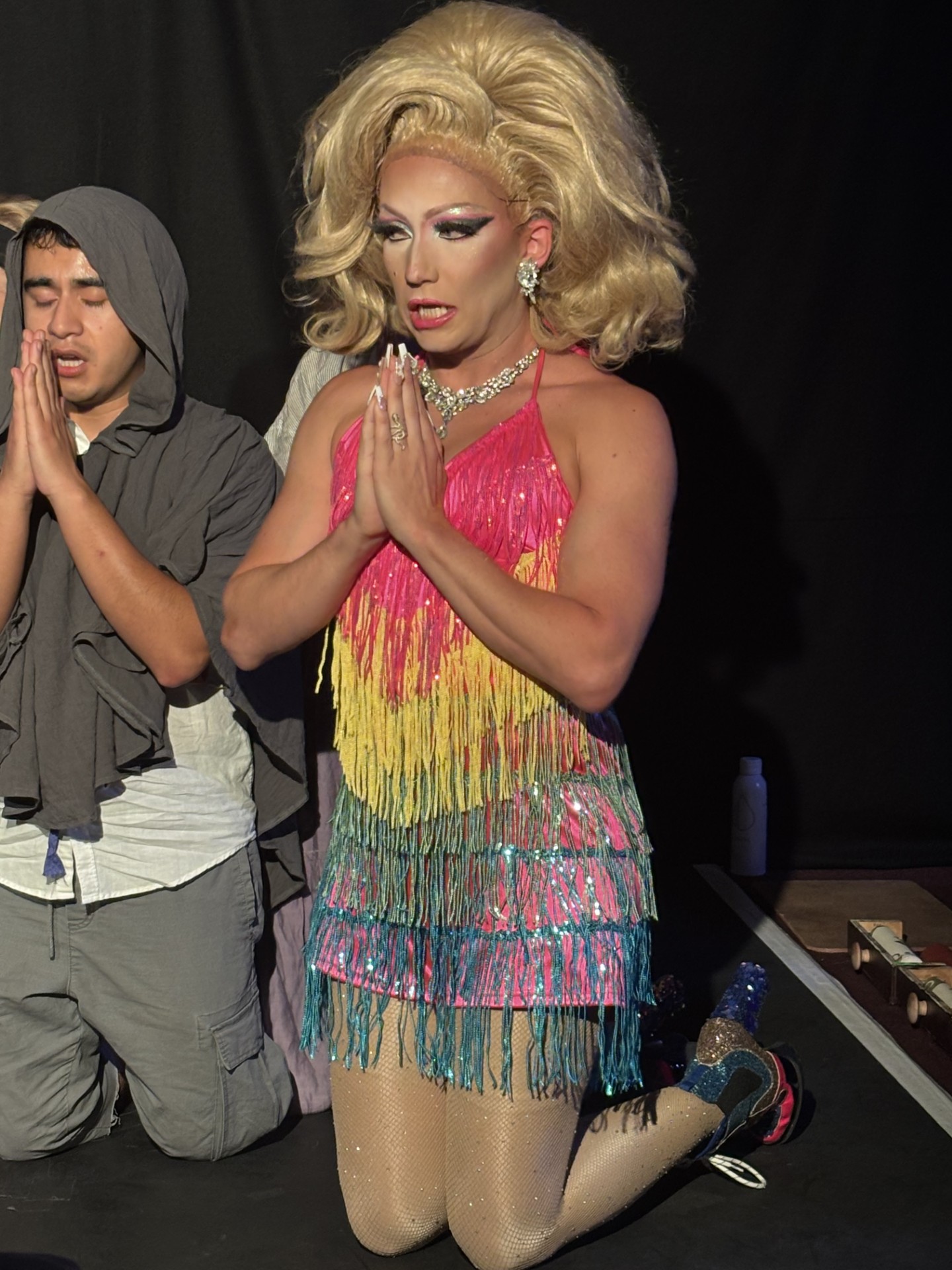
We loved the drag devil/angel narrator

Ponturo’s writing has that LA‑meets‑NYC flavour: punchy, self‑aware, and unafraid of silliness as a delivery system for something sharper. The production, created with Open Variations Theater, fits neatly into their mission of reimagining lesser‑known stories with contemporary bite. You can feel the interdisciplinary New York influence in the way the piece layers satire, history, and outright party vibes into a single 50‑minute burst.

And yes, it is a dance party. The show wants you complicit in the hysteria—laughing at it, recognising it, maybe even feeling the tug of it. The absurdity of people dancing themselves to death becomes a mirror held up to the way we cope with uncertainty now: distraction as survival, movement as denial, rhythm as rebellion.

It’s messy, cheeky, knowingly ridiculous, and unexpectedly tender. Exactly the sort of Fringe show that sneaks up on you: you arrive for the chaos, and leave thinking about the systems that shape how we behave when everything goes sideways.

If you’re looking for a satire with historical weirdness, queer heart, and a healthy disrespect for authority, 1518: The Dancing Plague earns its place on your August shortlist.

Reviewed by Pat Harrington

Click here for tickets

Leave a Comment

A Universe Without Boundaries: Gods, Monsters and Desire in Hasegawa’s Art

Leave a Comment

Inside The Bowie Story: How Peter Marchant Channels a Cultural Supernova

David Bowie didn’t just bend culture; he detonated it and then calmly walked through the smoke wearing something nobody had seen before. The Bowie Story promises to trace that volatility — the reinventions, the provocations, the sheer audacity of a man who treated identity as raw material. At the centre of Night Owl’s world‑premiere production is Peter Marchant, whose performance has already been described as “electric”.

In conversation, Marchant is thoughtful, curious, and disarmingly funny — but onstage he steps into Bowie’s slipstream, chasing the imagination that made him a lodestar for misfits, futurists, and anyone who ever felt the world might be bigger than the version they were handed.

This interview digs into the mythology, the music, the queerness, the chaos, and the craft behind The Bowie Story — and why Marchant believes Bowie’s relevance isn’t historical, but ongoing.

When you step onstage for The Bowie Story, are you channelling Bowie the icon, Bowie the innovator, or Bowie the cultural disruptor — and which of those feels most dangerous to inhabit.

A bit of all three I’d say, though if I had to pick one I’d say the cultural disruptor. I’m fascinated by what’s next in popular culture and Bowie wasn’t just interested in what was coming next, he created it. That’s a big focus in the story we tell.

Night Owl Shows thrive on narrative‑driven music experiences. What story about Bowie did you feel compelled to tell that other tributes always seem to miss.

I think the first few years of his career (before he was calling himself Bowie) was a topic I found quite interesting to research and I open up the show talking about this period. He tried various bands and pseudonyms during his teens but didn’t really achieve any success for years, which is crazy when you look at how legendary and influential he became.

Your performance is described as “electric” — what’s the current behind that charge: the music, the mythology, or the responsibility of carrying someone who reshaped the cultural landscape.

Again, probably a bit of all three. Above all it’s the passion for the artist. When the artist holds such a big place in my heart the energy I feel singing their songs comes from somewhere ‘not of this world’.

Bowie reinvented himself so often he almost made authenticity irrelevant. When you perform these songs, which version of him do you think audiences are really searching for.

The unshakable qualities of the man himself were always present in every one of Bowie’s different personas, that’s what I’m reaching for. The man behind the mask whose imagination and vision gave life to his characters.

Space Oddity, Life on Mars, Heroes, Let’s Dance — these tracks are cultural artefacts now. How do you stop them becoming museum pieces and make them feel volatile again.

So long as artists continue to talk about these songs and apply their messages to the world we live in today, they’ll stay relevant. Bowie perfectly predicted the future when talking about the Internet in his interview with Paxman in 1999 and I think that ability to predict the future helped him write songs that would hold eternal relevance.

Bowie blurred the line between persona and performance. Do you ever feel that same tension when leading an all‑star band through his catalogue.

The ways in which Bowie presented his different personas on each album was not just in how he dressed but was also in how he moved and even how he pronounced words — he puts on a bit of a New York twang in Rebel Rebel for example. That’s something I like to try and reflect when portraying his different personas and our band do a great job of showing how his use of sound and production techniques evolved over the years.

The show promises audiences a rediscovery of their favourite songs. What’s the one Bowie track that surprised you most once you started digging into its origins.

I was quite surprised when I found out that Young Americans was released less than a year after the Diamond Dogs album, where Bowie was still putting out a glam‑rock kind of persona. To go from that to his ‘plastic soul’ in such a short space of time is a pretty drastic and rapid transformation.

Bowie shaped pop culture by refusing to play by its rules. What’s the most rebellious choice you’ve made in crafting this show.

Refusing to wear boring trousers.

Night Owl Shows impose narrative clarity — but Bowie thrived on chaos. How do you create a coherent story around someone who resisted being pinned down.

It definitely wasn’t an easy task. Although within each phase of his career there was a lot of consistency — organised chaos you might say. I think when you go year by year and look at the context behind his creative decisions (i.e. his move from LA to Berlin to escape drug addiction and working with Eno and Visconti) the drastic changes he went through seem to make more sense.

Bowie was a trailblazer for sexual freedom, queerness, and self‑invention. When you embody his work, how consciously do you engage with that legacy — and what does it mean to perform songs that once helped people feel seen for the first time.

I speak about this a little bit when talking about his Ziggy years, making the character androgynous and gender‑fluid. But I think much of how I embody that comes from how I dress and move on stage (I do a lot of ass shaking on stage in my glittery trousers and sequin lightning bolt jacket). Hearing lyrics like “you got your mother in a whirl, she can’t tell if you’re a boy or a girl, hey babe your hair’s alright, hey babe let’s go out tonight” must have been very liberating and validating for queer people to hear for the first time.

See our review of The Bowie Story

Buy tickets for The Bowie Story

Advert

Leave a Comment

Boobytrapped: A Sharp, Funny and Emotionally Honest Dive into Identity and Masculinity

Click on image to buy ticket

Boobytrapped is sharp, funny, emotionally exposed, and built on the kind of lived experience that can’t be faked. When I first read Freddie’s answers, what struck me wasn’t just the craft behind the writing, but the clarity of purpose. This is a play that knows exactly why it exists and exactly what it wants to say — about bodies, identity, masculinity, queerness, and the strange, messy business of becoming yourself in a world that insists on telling you what you are.

There’s a generosity running through the interview too. Freddie doesn’t dodge the difficult parts — the frustration, the fear, the absurdity — but he also refuses to let heaviness swallow the humour. That balance is hard to pull off, and it’s part of what makes boobytrapped feel so alive. It’s a story built from real conversations, real contradictions, and real encounters with people who don’t always get it right. And that honesty gives the play its charge.

Below is the full interview with with writer, Freddie Haberfellner.

1. Your script treats a bodyswap not as a gimmick but as a way of exploring identity and perspective. When did you realise this supernatural twist could become the foundation of the story?

First of all, thanks so much for having me! The idea for a bodyswap play kind of just landed in my brain one night! I was roughly eight months on testosterone and somewhat starting to pass, had just received a date for top surgery (with more than a year’s wait ahead of me) and was spending more time around cis gay men. As a result, I was thinking a lot about what makes someone a man, how differently the world treats you based on how you’re perceived, all the different ways in which all of us attempt to affirm our gender and identity. On one hand, I was really surprised by how much I had common with the cis gays, how easy it was to feel like I was one of them and how welcome some of them made me feel. On the other hand, I was really shocked by the casual misogyny, bodyshaming and transphobia I encountered. I asked myself what I would have been like as a cis man, or how these guys would cope with being trans even for a day… and so the bodyswap seemed like the perfect way to find out!

2. Simon and Kevin wake up in one another’s bodies — but they also confront one another’s insecurities and assumptions. Which aspect of that dynamic was the hardest to write honestly?

Finding Kevin (the cis man)’s voice was definitely the biggest challenge, balancing his humanity whilst portraying the toxicity and prejudice I’ve experienced from a lot of cis gay men. I think the early drafts really reflect how much I was struggling because he barely spoke and when he did he mostly just said ‘What?’ He was really missing nuance, perhaps because I’ve been quite pissed off with (some) cis people for how they treat the trans community, or how even the ones who say they support us won’t show up as much as we need them to at this critical moment in time. But, as a writer, it’s not my job to tell people off! I had to figure out why Kevin treats Simon badly and find empathy for his pain, too. At the end of the day, we need to be hard on systems, not people – often easier said than done!

3. The show arrives at a moment when trans people are often spoken about rather than listened to. Did writing boobytrapped feel like a way of contributing your own perspective to that conversation?

Yes, absolutely. Putting on plays – both my previous show F*ckboy and now boobytrapped – is definitely my small way of standing up for my community. To say it’s frustrating to see the way we’re being spoken about would be an understatement, and the fact that the voice of misinformation and, let’s be real, hate speech is so loud and supported by some very powerful people is terrifying. We’re seeing over and over again that decisions concerning trans people’s basic human rights are being made without a single one of us being consulted, without unbiased research that is readily available actually being considered. I hope trans people like myself feel seen, understood and affirmed, but I’m also hoping that cis people seeing the show might learn a thing or two, and leave the theatre ready to double down on their support for the trans community.

4. The show is playful and funny, but it’s also set against the backdrop of debates around gender identity and the social climate referenced in your press materials. How do you balance humour with those heavier themes?

My therapist would tell you that humour is just how I cope with any difficult situation (I think they might be on to something there!). But being trans is silly, because being a human being is silly! Going through puberty again as an adult, dealing with the emotional and hormonal rollercoaster of that whilst holding down a job (or several)… it’s a goldmine for comedy in my opinion. But I think it’s so common in the queer community or any marginalised group to find the laughter in dire situations in order to maintain hope. Translated onto the stage, I always find that if a play is only sad, serious or heavy with no moments of joy and levity I’ll eventually check out emotionally, so it’s really important to me as an artist to always find the silliness and through that, perhaps, the humanity of a moment. And there’s more than enough trans tragedy out there: the prevailing narrative for too long has been that our lives are hard and miserable, full stop. While it’s true that our lives are made harder than they need to be, being trans is also an incredible gift that has brought me so much joy.

5. Body-swap stories often hinge on empathy and understanding. What questions did you most want audiences to ask themselves through Simon and Kevin’s journey?

One of the reasons I wanted to write this play was the insecurity I witnessed in myself and pretty much everyone around me regarding our own bodies. Wanting to look different, be different – bigger, smaller, more muscular, softer, harder… however we look, we always seem to think someone else looks better. I’ve been looking into the looksmaxxing movement and I’m simply horrified by the damage these young men do to themselves in order to reach some ‘ideal of masculinity’. But, of course, some people are of the opinion that I as a trans man am mutilating my own body by accessing gender-affirming care. I strongly reject that notion, yet it can’t be denied that there are similarities. So why do any of us feel the need to change our bodies? Why do we have these fixed ideas of what men and women look like? Why do our bodies determine how we are treated, what language people use about us? And how can we make peace with ourselves and the bodies we find ourselves in?

6. After touring Fckboy across Europe and receiving several awards, what part of that experience fed most directly into boobytrapped?

I love this question! I’ve absolutely loved performing F*ckboy but it’s also a very challenging and exhausting show to do. It is just my little self on the stage and I’ve definitely felt the pressure of that. So I think I was really craving collaboration with other performers and I’ve definitely found that with my wonderful co-star Ermis Makides as well as the whole team. My good friend Romeo Lau has been beyond brilliant as a director, Ro Winchester’s contribution as intimacy director has made some really difficult scenes easy and fun, and Callie O’Brien’s sound design really brought it all together. We’ve genuinely had such a blast workshopping and rehearsing this show, as well as previewing it at Prague Fringe. Plus, we’re all trans and non-binary people and it’s just been so special to be in a room with brilliant queer creatives who’ve poured so much love into my latest brain creation!

7. The gay-club setting feels vivid and central to the story. What drew you to that environment as the place where this extraordinary situation begins?

As so many transmasc people did, I grew into my queerness in sapphic spaces and I was very lucky to find some incredible community there with true care and togetherness. Once I realised that I was a) a man and b) really into men, I started spending more time in spaces predominantly frequented by cis gay men and, genuinely, I was really surprised by the difference in vibe. By no means are sapphic spaces perfect but, in my experience, they’re better at making everyone feel safe and welcome. So there was something really intriguing about starting the show in a place that, at first glance, is more welcoming to one of the characters than the other but, once you look closer, maybe isn’t the best place for either of them to be. A central theme of boobytrapped is definitely about feeling at home in your own body, but there is a wider theme of feeling at home in general. The gay club is the first of several potential homes we visit throughout the show. Slight spoiler here, but the characters also end up in the club’s accessible toilet which is where the body swap happens. I felt that was a necessary nod at the current attack on trans people’s right to use public toilets (as well as other gendered spaces).

8. The partnership with Waverley Care adds another dimension to the production. How did that collaboration come about, and what does it mean to you?

As a company, our goal isn’t just to make theatre but to use our art to inspire social change, to bring people together, make them feel less alone and raise awareness of queer struggles. Collaborating with a charity has been a goal of ours for quite some time and I’m so thrilled that we get to support Waverley Care’s vital work. Whilst sexual health isn’t a direct theme of the show, there definitely is a lot of talk about sex so their work almost feels like an extension of the play! We’ll have informational leaflets available to our audience members to hopefully raise awareness of HIV, hepatitis B, hepatitis C and general sexual health, and audiences will have the opportunity to donate too if they can. I’m also really excited to be doing a writing workshop with some of their service users. The focus will be on using your lived experience to create art but keeping yourself as emotionally safe as possible in the process. With two plays inspired by my life under my belt, I’ve learnt quite a lot along the way, and have also seen how empowering it can be to create art in this way. So being able to share this experience with other queer folks is an immense privilege.

9. Simon and Kevin’s relationship is messy, tender and often funny. What surprised you most about writing two characters with such different perspectives on masculinity and identity?

From the offset I knew that I wanted the play to be a romcom – there’s a dire lack of love stories especially for trans men – but I also knew that there would be some real obstacles for the characters to overcome. I didn’t want to trivialize or downplay the transphobia that happens at the beginning, but was also determined to show that people can learn and grow when given the opportunity. Whilst writing, I had a lot of wonderful conversations with my AMAB friends which really helped me to see all our similarities. The way we are all insecure about our bodies, about whether we’re desirable, whether we’re doing gender correctly (whatever that may mean)… With time, I realised that the two characters really are quite similar even though their struggles manifest in very different ways. They’re both damaged, they both make mistakes and hurt each other, but I’ve been genuinely surprised by the moments of care and softness we’ve found in between all the body swap madness.

10. If audiences leave theSpace on The Mile having seen the show, what do you most hope they take away from the experience?

I really need this on a shirt because I say it so often, but with any play I do I’ll genuinely be happy if I’ve made one person feel less alone. What I hope is that people leave the theatre with a strengthened sense of empathy – for themselves as well as each other. I hope their bellies ache from laughing. And I hope the cis audience members especially will have learnt a thing or two about the trans experience, and I hope they feel inspired to bring that knowledge into conversations going forward to help us raise awareness and fight the horrific amount of misinformation circulating at the moment. I hope trans and queer people seeing the show feel seen and held, and perhaps a little more in love with their own brilliant bodies.

Click here to buy ticket


Leave a Comment