★★★★★ There are Fringe evenings that feel pleasant, and then there are those that feel charmed. Andrea Carlson and the Love Police belongs firmly in the latter category. The Royal Scots Club’s Speakeasy room, with its warm wood and old‑world elegance, proves an ideal setting for a night steeped in vintage jazz. It’s the kind of space where you half‑expect a 1930s bartender to slide a cocktail across the counter.
The Love Police are, quite simply, superb. Dr Bruce Goldman’s double bass has that deep, velvety resonance that anchors the room; David “Bopdrummer” Yager’s percussion is crisp, playful, and beautifully controlled. Together they create a sound that feels both classic and alive, a proper jazz trio with real chemistry.
Andrea Carlson herself is a delight. Born in Memphis and trained in classical guitar at the American Conservatory of Music in Chicago, she brings a fingerstyle technique that instantly evokes the 1920s and 1930s. Her playing is elegant, intricate, and full of character. When she sings, the room softens. In English, her voice has a velvet warmth; in French Chanson, she is luminous. Her love for the Great American Songbook is evident, but her affection for French repertoire gives the evening a distinctive charm.
Her songwriting credentials are impressive, and she shares them with an easy humility. “Cryin’,” her award‑winning piece from the Philadelphia Songwriters Project, and “Mysterious Moon,” honoured at the Montgomery/Bucks Music Awards, both reveal her gift for melody and mood. She speaks openly about her catalogue of more than sixty songs, and when she performs “Let Me Cook for You”—featured in Jazz Bridges and the Philadelphia Real Book of Jazz—the audience responds with clear delight.
Carlson also offers glimpses of her upcoming performances in the United States, but these feel less like promotion and more like an artist sharing her journey. Her albums—Love Can Be So Nice, Driving Myself Wild, Aimez-vous bien, and Out of My Dreams—reflect the breadth of her musical world: jazz, blues, chanson, romance, and the unmistakable sound of her guitar.
The hour at The Speakeasy feels like stepping into a New Orleans jazz bar in its golden era. The musicianship is impeccable, the atmosphere warm, and Andrea’s presence—gracious, talented, and quietly magnetic—makes the evening unforgettable.
A gorgeous, nostalgic, and musically rich Fringe experience.
★★★★★ Marvin Herbert walks onto the stage with the calm assurance of someone who has lived several lives and survived all of them. What follows is not a performance in the theatrical sense, but a raw, unfiltered account of a man who refuses to hide from his past. He takes the audience through his childhood, teenage years, and adulthood with a level of honesty that is both disarming and compelling.
There is no glamour in the way Marvin describes the criminal underworld. He speaks plainly, almost clinically, about violence, loyalty, and the brutal logic of the life he once led. When he says he “loved violence,” the room tightens. It is not a boast; it is a confession. And it is this candour that makes his story land with such force. He never pretends to be anything other than what he was, and that truthfulness gives weight to everything that follows.
The turning point in Marvin’s life—his shift from gangster to crime‑prevention activist—is where the evening becomes genuinely powerful. He talks about working with young people, visiting prisons, and speaking in schools with a sense of purpose that feels entirely authentic. He knows the mindset of offenders because he lived it. He knows the excuses, the bravado, the fear. And because he does not sanitise his past, he has the credibility to reach those who trust no one.
Marvin’s tenacity is unmistakable. He speaks with conviction, but also with humility. There is no self‑pity, no attempt to rewrite history. Instead, he presents himself as a man determined to use his experiences to stop others from repeating them. His passion for reducing re‑offending is not theoretical—it is lived, urgent, and deeply personal.
By the end of the event, it is clear why audiences respond to him. Marvin Herbert is remarkable not because of the life he once led, but because of the life he is building now. Meeting him feels less like encountering a former gangster and more like witnessing a man who has fought his way into a new purpose and intends to drag as many people with him as he can.
A gripping, honest, and unexpectedly inspiring Fringe event.
★★★★ Agathi – The Plight of the Refugee speaks through movement, expression, and the weight of lived experience. The Apsaras Dance Company from Singapore bring Bharatanatyam to the Fringe with remarkable skill, precision, and emotional clarity. Their command of expression—eyes, hands, breath, stillness—is exceptional, and the story they tell through dance theatre is rich with feeling even without spoken word.
The performance unfolds through Bharatanatyam, Tamil song, and musical textures that carry the audience through themes of displacement and identity. The dancers’ storytelling is the strongest element of the production. Every gesture feels intentional. Sadness, fear, loneliness, and resilience are etched into their faces and bodies. At times the room feels heavy, as if the dancers are holding the audience in the quiet centre of their grief. More than once, the emotion is strong enough to bring a tear.
Where the production falters is in its audio‑visual layer. Poetry written by children appears on a distant screen, but the text is too far away to read clearly, and the connection between the visuals and the choreography is often unclear. The script behind the movement doesn’t always land, and there are moments where the narrative becomes difficult to follow.
Yet the dancers themselves never lose focus. Their portrayal of the refugee experience—displacement, loss of identity, the ache of leaving home, the fragile thread of hope—is powerful and deeply felt. The emotional truth of the piece comes through their bodies, not the screen.
At the end, Artistic Director Aravinth Kumarasamy explains that the work is inspired by her own experiences. Suddenly the production’s emotional intensity makes perfect sense. It is personal, and it shows.
A moving, beautifully performed piece of dance theatre that speaks from the heart, even when its multimedia elements fall short.
★★★★ There’s something immediately striking about walking into St Bride’s Centre for Edinburgh Days. The auditorium, with its worn wood and shadowed corners, feels steeped in history. It’s not a polished Fringe venue, and that works entirely in the production’s favour. The darkness, the age, the sense of a place that has held countless stories—perfectly matched to a Celtic rock, gothic‑tinged musical set in the 1800s.
The show opens on a world of hardship. The stage is dressed in muted tones, the costumes rough and work‑worn. Poverty hangs over the characters like a permanent fog. Yet the production never wallows. Instead, it channels that bleakness into something muscular and theatrical. The music—catchy, rhythmic, and surprisingly uplifting—cuts through the gloom with real force. The Celtic rock influence gives the score a pulse that keeps the audience leaning forward.
The cast throw themselves into the material with conviction. Jaydean Cramb’s Jean is a standout: fierce, grounded, and emotionally clear. Debbie McKenna brings a quiet strength to Mary, while Orla Jones’ Catriona has a sharp, compelling presence. Dave Graham, as Dunoon, anchors the darker moments with a performance that feels lived‑in and honest. Together, they create a community onstage—fractured, struggling, but undeniably alive.
The production’s ambition is unmistakable. This is a large, sweeping musical with a full emotional arc, not a quick Fringe sketch. And that ambition is admirable. The only drawback is the running time. At over two hours, the show stretches beyond typical Fringe expectations, and there are moments where tightening the pace would sharpen the impact. A 90‑minute version would likely land with even greater power.
Still, Edinburgh Days has atmosphere, heart, and a strong ensemble driving it forward. It’s a bold piece of theatre that embraces its gothic grit and Celtic soul, and the venue’s old bones only deepen the experience.
A dark, stirring musical with memorable performances and a score that lingers.
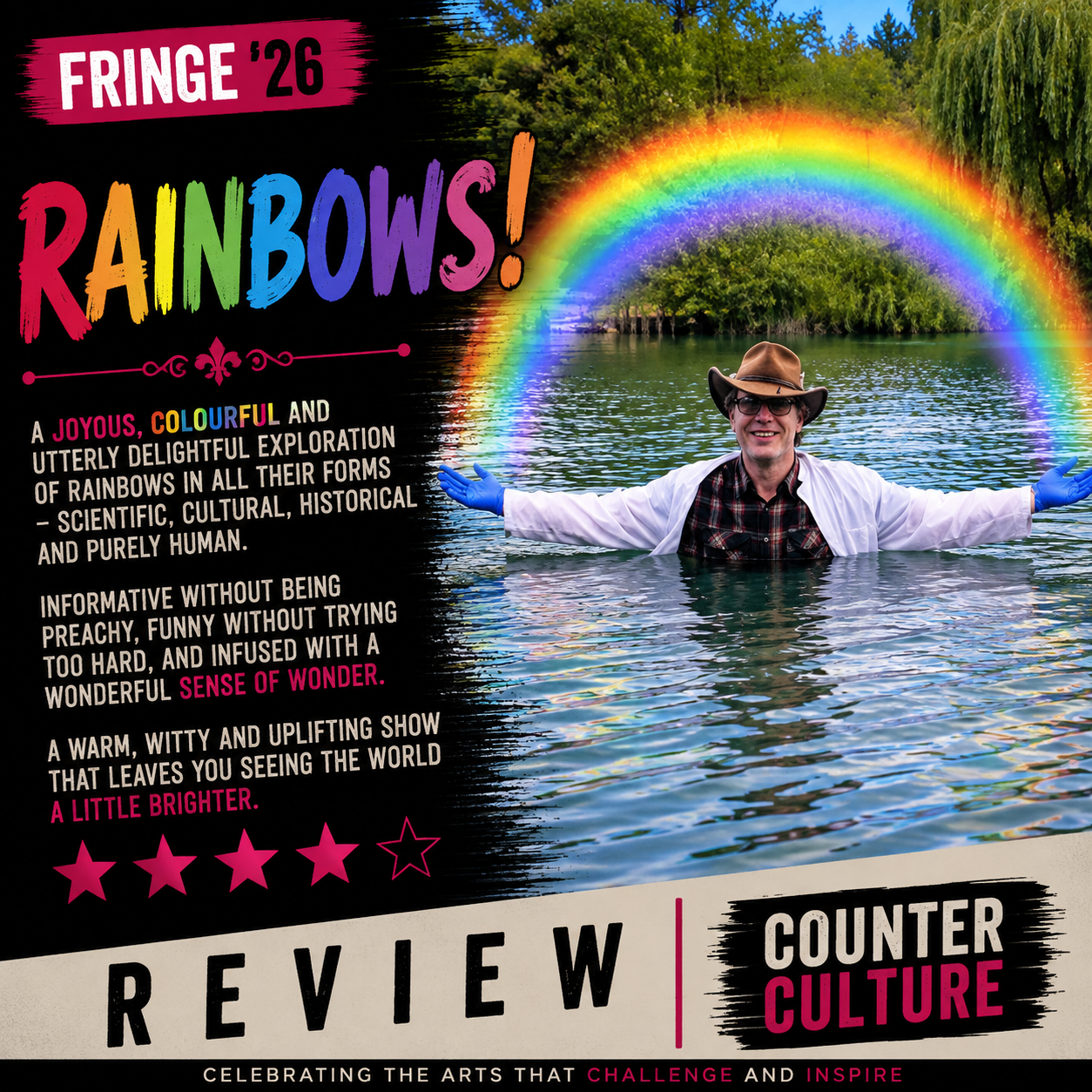
★★★★ There are Fringe shows that promise wonder, and then there are those that simply deliver it. Rainbows! sits firmly in the latter camp. Tim Clarkson, scientist, performer, and unabashed enthusiast for all things colourful, strides onto the stage with the easy confidence of someone who knows he’s about to surprise you.
What follows is a compact burst of curiosity and delight. Clarkson mixes chemicals with the precision of a seasoned researcher, yet presents each experiment with the warmth of a favourite teacher. Four different rainbow effects appear before our eyes—each one distinct, each one met with a ripple of disbelief from the audience. It’s not showmanship for its own sake; it’s science made visible, tangible, and unexpectedly beautiful.
There’s a gentle rhythm to the hour. After the fizz and glow of the chemical demonstrations, Clarkson shifts gears and brings out his rock collection. It’s an unexpectedly charming moment: a scientist sharing treasures like a child emptying their pockets after a day outdoors. He holds each specimen up to the light, revealing the subtle rainbow hues hidden in their mineral structures. The audience leans in, drawn by the quiet magic of colour emerging from stone.
The production is simple, but simplicity works in its favour. Clarkson and his assistant keep the pace brisk without rushing, allowing each experiment to land fully. Children watch with wide‑eyed fascination; adults smile at the clarity and joy of the explanations. It’s rare to find a Fringe show that genuinely suits all ages without compromise, but this one manages it with ease.
By the end, the room feels lighter—brightened not just by the colours on display, but by the sense of shared discovery. Clarkson’s enthusiasm is infectious, and his ability to make science feel playful is a gift.
★★★★ There is always a particular pleasure in seeing an artist step into new territory, especially one as seasoned and versatile as Ali Affleck. Known across the Fringe for her jazz, blues, folk and traditional roots performances, Affleck arrives this year with something different: a heartfelt celebration of classic Country music and the women who shaped it – Ali Affleck Presents the Queens of Country.
The Club Room at the Scottish Arts Club is an intimate space, warmly lit and comfortably arranged, and it suits this show perfectly. Affleck leans into that homely atmosphere, creating what feels less like a formal concert and more like a gathering in someone’s living room — a place where stories, songs and memories can settle easily.
Country music may be new ground for her, but she embraces it with obvious affection. She has chosen the repertoire herself, drawing from the greats: Patsy Cline, Dolly Parton, Loretta Lynn and Tammy Wynette. There is a particular tenderness when she speaks about Loretta Lynn, whose songs she delivers with a mix of reverence and bright, personal joy. Affleck’s voice, rich and expressive, adapts beautifully to the storytelling heart of Country — the longing, the humour, the grit and the sweetness.
She is supported by a superb band, each musician bringing their own flair to the evening. Timmy Allen’s award‑winning guitar work is crisp and confident; Roy Percy’s bass lines are warm and grounding; Jim Drummond’s drumming adds subtle lift and drive; and Duncan Findlay rounds out the ensemble with easy, assured musicianship. Together they create a sound that fills the room without overwhelming it — a balanced, generous accompaniment that lets Affleck shine.
Affleck’s connection with the audience is relaxed and genuine. She chats between songs, sharing her enthusiasm for the material and her delight in exploring a genre she has long admired. There is no attempt to reinvent Country here; instead, she honours its traditions, its women, and its emotional directness. The result is a show that feels both fresh and familiar, carried by affection rather than imitation.
This is not her only Fringe offering this year — she also presents Ali Affleck’s Queens of Swing at the Argyle Cellar Bar — but Queens of Country stands out for its warmth and simplicity. It is a lovingly curated tribute to the women who defined the genre, performed by an artist who understands how to make a room feel at ease.
The music echoes beautifully around the Club Room, the band are a joy to hear, and Affleck’s charm carries the evening effortlessly. For anyone who loves traditional Country — or simply loves seeing a performer stretch into new creative spaces — this show is well worth seeking out.
★★★★★ There is something quietly arresting about walking into a Fringe venue first thing in the morning and finding a single storyteller ready to guide you through one of the most scrutinised moments in modern history. Martin Fitzgerald stands alone onstage, but the world he unfolds is crowded with faces, fragments, and fleeting moments that have shaped how we remember the assassination of John F. Kennedy.
Rather than beginning with the spectacle of Main Street — the crowds, the noise, the pageantry — Fitzgerald leads us instead to the quieter corner of Dealey Plaza. It is here, among a small cluster of bystanders, that the stories he tells take root. His interest is not in the grand narrative of the assassination, but in the ordinary people who found themselves caught in its periphery and spent the rest of their lives unable to step out of its shadow.
He introduces us to the man with the umbrella, the woman with the Polaroid camera, the dressmaker who filmed the motorcade despite battling vertigo. Each figure is presented not as a puzzle to solve, but as a human being whose presence at that moment became part of the cultural imagination. Fitzgerald’s storytelling is brisk, clear, and deeply humane. He moves from one character to the next with a lightness that keeps the audience engaged while never trivialising the weight of the event.
There is humour woven throughout — gentle, observational, and perfectly timed. Fitzgerald understands that conspiracy theories can be both absurd and revealing, and he allows the audience to enjoy the strangeness without ever losing sight of the people at the centre of these myths. His tone is warm and restrained, inviting curiosity rather than feeding speculation.
What makes the production compelling is the balance he strikes between true‑crime intrigue and emotional insight. He explores how these bystanders shaped public understanding of the assassination, but also how the moment shaped them. Some became symbols, others vanished into anonymity, and all were changed by the brief seconds in which history swept past them.
The staging is simple, allowing the storytelling to take precedence. Visuals punctuate the narrative, offering glimpses of the individuals whose lives intersected with the event. Fitzgerald’s delivery is calm and assured, drawing the audience into the quiet corners of Dealey Plaza and the lives that unfolded there.
This adaptation of his recent book carries the same clarity and depth that critics have praised. It is smart, thoughtful, and unexpectedly moving — a reminder that history is often shaped not by those at the centre of the frame, but by those standing just outside it. Fitzgerald’s ability to illuminate the humanity behind the mythology makes this a standout piece of spoken‑word theatre at this year’s Fringe.
A quietly powerful, beautifully crafted production that lingers long after the final image fades.
★★★★★ Some venues feel like they’re waiting for the right musicians to unlock them. The Queen’s Hall auditorium — all warm wood, elegant height and natural resonance — is one of those spaces. On this Fringe evening it becomes a perfect home for Le Vent du Nord, whose instruments sit across the stage like a small travelling museum of Quebec’s musical heritage.
The band’s roots stretch back to Saint‑Antoine‑sur‑Richelieu in Quebec, where the group was founded in 2002 by Nicolas Boulerice, Olivier Demers, Sébastien Dufour and Frédéric Samson. Over the years the ensemble has grown and shifted, welcoming Benoit Bourque, Bernard Simard, Réjean Brunet, and in late 2017, André Brunet. Their newest member, André (Dédé) Gagné, joined in March 2024, adding fresh energy to a group already rich in tradition.
Tonight’s line‑up showcases the full breadth of their craft:
André Brunet — vocals, fiddle, and the distinctive seated foot percussion known as podorythmie.
André (Dédé) Gagné — guitar, Irish bouzouki, vocals.
Nicolas Boulerice — vocals, hurdy‑gurdy, piano accordion, piano.
Québécois folk music is a tapestry woven from French and Celtic threads — echoes of Brittany, Normandy, Ireland and Scotland carried across centuries. Le Vent du Nord honour that lineage without ever feeling bound by it. Their sound is rooted, but never static; traditional, but never nostalgic. The rhythmic foot‑tapping, heard even from the back rows, becomes a heartbeat under the melodies — steady, earthy, and unmistakably Québécois.
The instruments themselves create a vivid soundscape. The hurdy‑gurdy’s mechanical drone cuts through the hall with a hypnotic hum; the bouzouki rings bright and clear; the accordion breathes with warmth; fiddles dance across reels and laments; guitars and piano round everything with a grounded, human pulse. It is a music that feels both ancient and immediate, carried by musicians who understand its history and its living present.
Since releasing their debut album Maudite Moisson in 2003, the band have produced a dozen more recordings. Their most recent confirmed band album is Territoires (2019), though individual members have released other projects since. Awards have followed them throughout their career: two JUNO Awards, the Grand Prix du Disque Charles Cros, a Songlines Music Award, and multiple Canadian Folk Music Awards. Yet none of that quite captures what happens in the room tonight.
The audience respond with unfiltered joy — clapping, tapping, singing, and leaning forward as though pulled by the music itself. There is generosity in how the band share their stories, their humour, and their heritage. They speak about their long touring life, their influences, and the traditions they carry. It feels less like a concert and more like being welcomed into a culture.
Their Fringe performance is one stop in a long international tour running from September through February 2027, with dates across Canada, the US and the UK. But nothing on a tour list can quite convey the atmosphere of this night: five musicians, each a master of their craft, filling the Queen’s Hall with a sound that is both deeply rooted and joyfully alive.
Le Vent du Nord deliver a Fringe concert that is technically superb, emotionally uplifting, and rich with cultural depth. It is the kind of performance that lingers — in the tapping of a foot, the hum of a drone, the memory of a room full of people carried together by music.
★★★★★ Lanford Wilson’s work has always thrived in the margins—those quiet, unguarded moments where people reveal themselves without meaning to. Deep Flight Productions lean into that instinct with real clarity in this alternating double‑bill, pairing the absurd domestic rupture of Breakfast at the Track with the tense, slow‑unfolding confession of A Poster of the Cosmos. Seen together, they form a compact but surprisingly resonant study of human connection under pressure.
Breakfast at the Track
Publicity material describes this as an “absurdist dark comedy” about a couple at domestic breaking point, and that’s accurate—but it undersells the strange, brittle charm of the piece. Wilson’s script is a ten‑minute pressure cooker: repetitive, circular, and deliberately trivial, yet shot through with the unmistakable ache of two people who no longer know how to speak to one another.
Geoff Stoner and Margaret Curry play the unnamed couple with a taut, lived‑in chemistry — Stoner simmering under the weight of unspoken frustration, Curry matching him beat for beat with a performance that turns quiet resignation into something quietly explosive.
Geoff Stoner and Margaret Curry
Performed here as a two‑hander—a pre‑dawn hotel‑room encounter between a couple —the play works because the performers refuse to soften it. The rhythm is sharp, almost mechanical, but never robotic. There’s humour, yes, but it’s the kind that comes from desperation rather than levity. You feel the weight of the ritual, the way repetition becomes a shield against the truth neither wants to name.
It’s a miniature, but a well‑judged one: a quick, jagged inhale before the longer, darker exhale that follows.
A Poster of the Cosmos
If Breakfast at the Track is all surface tension, A Poster of the Cosmos is the slow reveal of what happens when that tension finally breaks. Set in a Manhattan police station, where a man recounts events under interrogation , the play begins in a register of defensiveness and agitation. The character pushes the audience away, almost daring us to misunderstand him.
It’s an alienating start—but deliberately so. Wilson’s writing is built on deferred exposition, and Deep Flight’s staging honours that. The monologue gradually shifts from hostility to something far more fragile, as the man’s long‑term relationship comes into focus and the emotional logic of his behaviour begins to make sense. What initially reads as anger reveals itself as fear; what looks like self‑absorption becomes grief.
Geoff Stoner delivers A Poster of the Cosmos as a tightly coiled, quietly devastating monologue — a man circling his own memories like unstable orbit, letting the cracks show only when he can no longer hold the centre.
The production handles the AIDS‑era context with restraint. Nothing is sensationalised, nothing is framed as a twist. It’s simply the truth the character has been circling, unable to articulate it cleanly. The performance is tightly controlled—no melodrama, no pleading for sympathy. The contradictions are allowed to stand: shame, tenderness, panic, devotion. It’s a portrayal that understands grief as something jagged and unresolved.
This is a piece that improves in retrospect. During the performance, the emotional distance can feel like a flaw; afterwards, it feels like part of the design. The monologue lingers because it quietly rearranges your understanding of the man at its centre. That’s certainly how it worked for me.
Together as a Programme
The two plays are distinct in tone yet thematically linked, tracing “moments when ordinary lives are tested and reshaped” . The pairing works because it creates an emotional arc: the brittle absurdity of Breakfast at the Track primes you for the deeper rupture of A Poster of the Cosmos.
The second play is unquestionably the stronger, but the first is essential. Without it, Cosmos might feel too stark; with it, the evening becomes a study in contrast—light and heavy, immediate and reflective, comic surface and emotional depth.
Deep Flight Productions continue to show why Wilson’s work still resonates: minimalism, honesty, and a willingness to trust the audience. This is Fringe theatre doing exactly what Fringe theatre should—small stories, told with care, that open into something unexpectedly large.
Pip: Counter Culture, where the Fringe is apparently where history goes to settle its unfinished business — one trapdoor, one trench, and one medieval dance floor at a time.
Mara: Patrick Harrington’s been at the Edinburgh Fringe this season, and the posts cover a lot of ground — forgotten figures reclaimed from history’s margins, soldiers written out of the record, and a five-star comedy built on genuine medieval chaos.
Pip: Let’s start with the figures history couldn’t quite decide what to do with.
Forgotten Figures And Reputations
Mara: Two shows, two people history has handled badly — one erased, one misread. The question both productions are asking is whether theatre can correct that imbalance.
Pip: The Pierrepoint review sets the stakes early. The show, it says, “invites us to see the world through the executioner’s eyes” — not to excuse him, but to actually look.
Mara: And what that gets the audience is a figure who resists easy framing. Pierrepoint executed an estimated 435 people across roughly twenty-five years, including Ruth Ellis and John Reginald Christie, whose crimes anchor the production’s strongest material.
Pip: The review’s honest about where the show falls short — Christie gets the room, Pierrepoint’s own moral evolution gets squeezed into whatever’s left of a one-hour Fringe slot.
Mara: The Constance Lloyd show runs the opposite direction. Mrs Oscar Wilde gives its subject the full hour, and Lexi Wolfe’s performance, built through Constance’s own letters, means she “emerges from the margins of history to reclaim her place in a story that has long overlooked her.”
Pip: One show slightly underserves its subject, one finally serves hers. Both earn four stars or better — which suggests the Fringe is doing something right even when the scripts aren’t quite finished.
Mara: The soldiers history overlooked deserve the same treatment — and that’s where we’re headed next.
War Stories And Hidden Soldiers
Mara: The Last Bantam is about thirty thousand men under five-foot-three who volunteered for the Great War — and about how thoroughly they were written out afterward.
Pip: Michael Hughes, who wrote and performs the show, explains in an interview how his Dubliner protagonist Patrick Michael Wolfe signed up not for money but for Irish Home Rule — fighting in British uniform for a political future that was already slipping away.
Mara: The review puts it plainly: “History has been kind to the Dublin insurrections of 1916 and the Ulstermen of the 36th Ulster Division. Not so, the tens of thousands of Irishmen who served in the British Army in that conflict.”
Pip: So the upshot is that the Bantams were embarrassing to two different national stories simultaneously — too British for Irish memory, too Irish for British comfort.
Mara: Hughes describes in the interview how he shaped that tension through Wolfe’s letters home — a man who feels betrayed by the Easter Rising rebels, who wonders why they weren’t in the trenches with him. It’s the most contentious material in the show, and possibly why Dublin venues have been reluctant to host it.
Pip: From soldiers nobody wanted to claim, to a city that danced itself to death — which turns out to be its own kind of historical embarrassment.
Absurdity And Dark Humor
Pip: Strasbourg, 1518: citizens dancing compulsively in the streets until some of them die. The real event. The show leans in.
Mara: The review describes 1518: The Dancing Plague as inviting audiences to “shake your a** and dance ’til you (hopefully don’t!) die” — and means it as a promise, not a warning.
Pip: That’s the frame: a medieval mass hysteria retold as a late-night Fringe party where the joke and the dread arrive in the same beat.
Mara: Hannah Ponturo’s script wraps the chaos around a queer romance between two peasants, Katherine and Anna, whose relationship reignites as the city falls apart. The production draws explicit parallels to recent crises — Covid, institutional panic, the spectacle of authorities scrambling while ordinary people try to make sense of the mess.
Pip: The absurdity of people dancing themselves to death becomes, as the review puts it, “a mirror held up to the way we cope with uncertainty now: distraction as survival, movement as denial, rhythm as rebellion.”
Mara: What this gets the audience is something that arrives as chaos and lands as critique. The review calls it “messy, cheeky, knowingly ridiculous, and unexpectedly tender” — you come for the hysteria, you leave thinking about the systems underneath it.
Pip: Five stars for a show about dying of dancing. The Fringe remains a place where that sentence is completely normal.
Mara: And that’s the thread running through everything this week — theatre as the place where history’s unresolved arguments get another hour to breathe.
Pip: Executioners, forgotten wives, Bantam soldiers, dancing plagues — it’s a strange list until you notice they’re all asking the same question: who does history decide to remember, and why.
Mara: The shows that answer that best seem to be the ones that trust the audience to sit with the contradiction rather than resolve it neatly.
 ★★★★★ There are Fringe evenings that feel pleasant, and then there are those that feel charmed. Andrea Carlson and the Love Police belongs firmly in the latter category. The Royal Scots Club’s Speakeasy room, with its warm wood and old‑world elegance, proves an ideal setting for a night steeped in vintage jazz. It’s the kind of space where you half‑expect a 1930s bartender to slide a cocktail across the counter.