Archive for Solo

Hard Truths and Real Change in An Audience with Marvin Herbert

An Audience with Marvin Herbert Edinburgh Fringe review graphic★★★★★ Marvin Herbert walks onto the stage with the calm assurance of someone who has lived several lives and survived all of them. What follows is not a performance in the theatrical sense, but a raw, unfiltered account of a man who refuses to hide from his past. He takes the audience through his childhood, teenage years, and adulthood with a level of honesty that is both disarming and compelling.

There is no glamour in the way Marvin describes the criminal underworld. He speaks plainly, almost clinically, about violence, loyalty, and the brutal logic of the life he once led. When he says he “loved violence,” the room tightens. It is not a boast; it is a confession. And it is this candour that makes his story land with such force. He never pretends to be anything other than what he was, and that truthfulness gives weight to everything that follows.

The turning point in Marvin’s life—his shift from gangster to crime‑prevention activist—is where the evening becomes genuinely powerful. He talks about working with young people, visiting prisons, and speaking in schools with a sense of purpose that feels entirely authentic. He knows the mindset of offenders because he lived it. He knows the excuses, the bravado, the fear. And because he does not sanitise his past, he has the credibility to reach those who trust no one.

Marvin’s tenacity is unmistakable. He speaks with conviction, but also with humility. There is no self‑pity, no attempt to rewrite history. Instead, he presents himself as a man determined to use his experiences to stop others from repeating them. His passion for reducing re‑offending is not theoretical—it is lived, urgent, and deeply personal.

By the end of the event, it is clear why audiences respond to him. Marvin Herbert is remarkable not because of the life he once led, but because of the life he is building now. Meeting him feels less like encountering a former gangster and more like witnessing a man who has fought his way into a new purpose and intends to drag as many people with him as he can.

A gripping, honest, and unexpectedly inspiring Fringe event.

Reviewed by Jacqueline Sharp

Leave a Comment

Science, Colour and Wonder in a Charming Fringe Hour

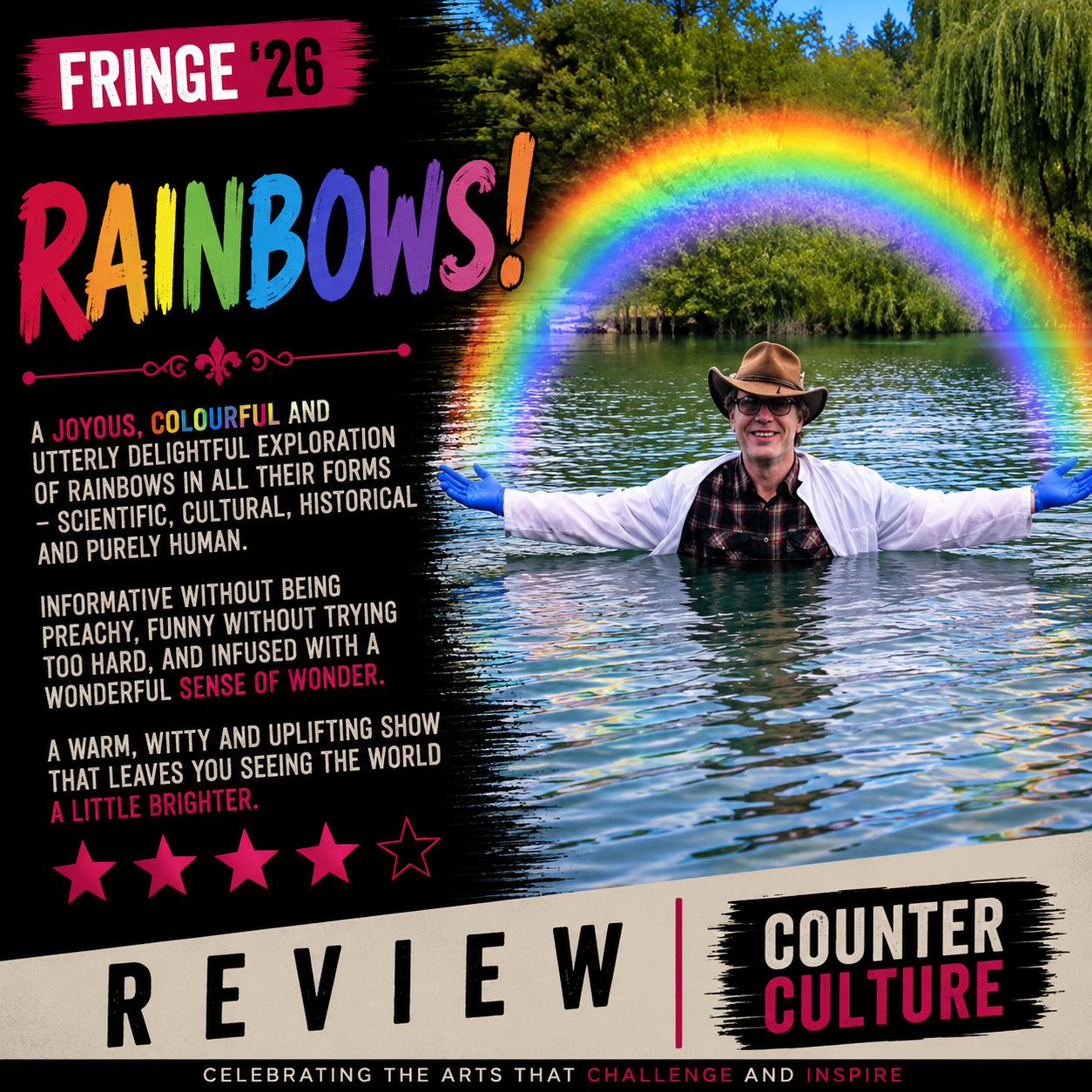
Rainbows! Edinburgh Fringe science show review graphic★★★★ There are Fringe shows that promise wonder, and then there are those that simply deliver it. Rainbows! sits firmly in the latter camp. Tim Clarkson, scientist, performer, and unabashed enthusiast for all things colourful, strides onto the stage with the easy confidence of someone who knows he’s about to surprise you.

What follows is a compact burst of curiosity and delight. Clarkson mixes chemicals with the precision of a seasoned researcher, yet presents each experiment with the warmth of a favourite teacher. Four different rainbow effects appear before our eyes—each one distinct, each one met with a ripple of disbelief from the audience. It’s not showmanship for its own sake; it’s science made visible, tangible, and unexpectedly beautiful.

There’s a gentle rhythm to the hour. After the fizz and glow of the chemical demonstrations, Clarkson shifts gears and brings out his rock collection. It’s an unexpectedly charming moment: a scientist sharing treasures like a child emptying their pockets after a day outdoors. He holds each specimen up to the light, revealing the subtle rainbow hues hidden in their mineral structures. The audience leans in, drawn by the quiet magic of colour emerging from stone.

The production is simple, but simplicity works in its favour. Clarkson and his assistant keep the pace brisk without rushing, allowing each experiment to land fully. Children watch with wide‑eyed fascination; adults smile at the clarity and joy of the explanations. It’s rare to find a Fringe show that genuinely suits all ages without compromise, but this one manages it with ease.

By the end, the room feels lighter—brightened not just by the colours on display, but by the sense of shared discovery. Clarkson’s enthusiasm is infectious, and his ability to make science feel playful is a gift.

Reviewed by Jacqueline Sharp

Comments (1)

A Forgotten Woman: Mrs Oscar Wilde – A Powerful, Humane Solo Show at Edinburgh Fringe

A Forgotten Woman: Mrs Oscar Wilde theatre review graphic

Click on image to buy tickets

★★★★★ History has never been kind to Constance Lloyd. She appears in the margins of Oscar Wilde’s story — a footnote, a casualty, a name occasionally invoked but rarely explored. A Forgotten Woman: Mrs Oscar Wilde sets out to correct that imbalance, and in Lexi Wolfe’s hands, Constance finally steps out of the shadows with a voice that feels fully, fiercely her own. As the press release puts it, Wolfe “brings Constance Lloyd vividly to life in a powerful solo performance told through her letters” . This is a one‑woman show, but it never feels small. Through Constance’s letters — intimate, witty, and edged with quiet defiance — Wolfe constructs a portrait of a woman navigating love, intellect, motherhood, and public scandal. The production’s description notes that her voice “emerges from the margins of history to reclaim her place in a story that has long overlooked her” , and that is precisely what the performance achieves. It is not an act of historical correction; it is an act of reclamation. Wolfe’s performance is the anchor. She plays Constance not as a tragic adjunct to Wilde but as a woman of her own convictions — politically engaged, artistically curious, and emotionally complex. The show traces her life with clarity: the early promise, the marriage, the children, the intellectual pursuits, and the devastating public fallout of Wilde’s trial. What could have been a familiar narrative of suffering becomes instead a study in resilience. Constance’s wit is sharp, her warmth genuine, and her refusal to disappear quietly is rendered with understated power. The production’s history adds weight. First developed at the Buxton Fringe, Wolfe earned Best Actor nominations in 2016 and 2017, and the show now arrives in Edinburgh “in a newly reimagined form” . Her track record — including Best Actress wins for After Shakespeare (2021) and Baker Street Ladies (2025) — shows an artist who thrives in character‑driven work. This piece feels like the conrinuation of that trajectory. Constance Lloyd production photograph accompanying Mrs Oscar Wilde reviewThe staging is simple but effective. A solo show about letters demands intimacy, and theSpace @ Symposium Hall provides it. The 17:05 slot suits the tone: a reflective hour at the end of the afternoon, where audiences can sink into the quiet emotional resonance of the piece.  The show is bold not in spectacle but in its insistence on centring a woman history tried to erase. Even more affecting is the quiet sadness that runs through Constance’s recollections. When she speaks of her love for Oscar, there’s a sincerity and gentleness that makes the tragedy sharper; she talks about him with hope, with loyalty, with the assumption that their shared life will endure. We, of course, know it won’t. That inevitability hangs over the hour, turning even her happiest memories into something fragile. And in the final moments, when she wonders how she will be remembered — or whether she will be remembered at all — the piece lands with unexpected force. It becomes not just a story of a woman overshadowed by scandal, but a meditation on legacy itself: what survives, what is lost, and who history chooses to forget. Wolfe never overplays the tragedy; she lets the audience feel its weight through the words themselves. The result is quietly devastating.  A Forgotten Woman is not just a biographical monologue. It is a reclamation. It reminds us that history is often written by those who survive scandal, not those who endure it. Constance Lloyd deserves better than the footnote she was given. Wolfe gives her the dignity of a full story. A moving, intelligent, and quietly powerful hour — one of the most humane solo performances at this year’s Fringe. Reviewed by Pat Harrington Buy tickets here
 

More Fringe theatre about family and relationships

Body Parts

Comments (1)

A Family Trade, a National Debate: Pierrepoint’s Life Condensed into One Hour of Compelling Theatre

pierrepoint — illustration for A Family Trade, a National Debate: Pierrepoint’s Life Condensed into One Hour of Compelling Theatre

Click on image to buy tickets

★★★★ Albert Pierrepoint remains one of the most unsettling yet compelling figures in British criminal history, and Pierrepoint: The People’s Hangman approaches him with a seriousness that suits the subject. Rather than sensationalising his work or turning him into a caricature of grim authority, Andrew Hogarth attempts something far more ambitious: it invites us to see the world through the executioner’s eyes.

Pierrepoint served as Britain’s principal hangman for roughly twenty‑five years, executing an estimated 435 people between the 1930s and 1950s. His career intersected with some of the most notorious murderers of the era — John Haigh, the Acid Bath Killer; Ruth Ellis, the last woman hanged in Britain; and John Reginald Christie of 10 Rillington Place, whose crimes form the backbone of this production.

The show’s strongest material lies in its treatment of Christie. Rather than presenting him simply as a monster, the production dissects his crimes with forensic clarity, exploring not only what he did but how he came to be standing on Pierrepoint’s trapdoor. Christie’s murders — committed in the suffocating confines of 10 Rillington Place — are examined with a clinical, unsettling intimacy. We see the bureaucratic machinery of justice grinding forward, and Pierrepoint positioned at its final, irreversible stage.

Professionalism, Precision, and a Missing Piece

One of the most compelling aspects of Pierrepoint’s life — and something the production hints at but never fully explores — is his almost mathematical approach to execution. He believed deeply in the dignity of his work and the necessity of performing it with precision.

Pierrepoint openly criticised the Americans for their botched hangings of Nazi war criminals after the Nuremberg trials. In his autobiography, he described their methods as clumsy, miscalculated, and needlessly cruel, with several condemned men taking far too long to die because the drop lengths were wrong.

This detail is not included in the production, but it would have enriched it enormously. It illustrates Pierrepoint’s broader philosophy: if the state is to take a life, it must do so swiftly, cleanly, and without unnecessary suffering. Including this would have given audiences a clear example of his professional ethos.

A Family Business

One of the surprises in the show — and a detail that many will not know — is that Pierrepoint came from a long line of executioners. His father Henry began in 1901, his uncle Thomas in 1906, and Albert himself took up the role in September 1932. This wasn’t a macabre calling; it was, in a very real sense, the family trade. The production handles this well, and it adds a fascinating layer to Pierrepoint’s character: he was stepping into a legacy as much as he was taking on a job.

The Challenge of a One‑Hour Biography

This is where the production struggles. A one‑hour Fringe slot is a notoriously tight container for a life as complex as Pierrepoint’s. Choices must be made about what to include and what to sacrifice. Here, the balance tilts too heavily toward the criminals he executed — Christie in particular — at the expense of exploring Pierrepoint’s own motivations, philosophies, and contradictions.

The result is a show that is fascinating, but not fully balanced. The narrative structure is clear, but the weighting of material feels slightly off. Pierrepoint’s inner world, his moral evolution, and his reflections on capital punishment deserve more space. That imbalance is the reason this review lands at four stars rather than five. The script simply needs fine‑tuning.

Potential, Audience Appetite, and the Ongoing Debate

The Fringe is the perfect environment for a show like this. Productions can evolve rapidly in response to audience and critical feedback, and this one has all the ingredients to become a truly exceptional piece. With some structural refinement, it could easily reach five‑star territory.

There is also a substantial audience for this kind of work. True crime has become a cultural phenomenon; dramatizations of cases like Ruth Ellis continue to draw viewers decades later. Pierrepoint himself is strangely under‑examined in modern media, despite his central role in some of the most infamous cases of the 20th century.

And, of course, the debate around capital punishment is far from settled. Today, support for the death penalty often comes not from belief in deterrence but from a visceral desire for retribution, particularly in cases involving children. The show touches on this, but could go further — and doing so would deepen its relevance.

Verdict

Pierrepoint: The People’s Hangman is a thought‑provoking, tightly performed, and quietly unsettling piece of theatre. It neither glorifies nor condemns Pierrepoint; instead, it presents the contradictions and lets them breathe. With a more balanced script — one that gives equal weight to the man and the crimes that defined his career — this could become one of the standout productions of the Fringe.

For now, it is a strong four‑star show, rich with potential and already one of the most intriguing pieces of the year.

Reviewed by Pat Harrington
Click here for tickets


Leave a Comment

Nude Confronts the Male Gaze with Wit, Rawness, and Feminist Bite

nude2 — illustration for Nude Confronts the Male Gaze with Wit, Rawness, and Feminist Bite

Click on image to buy ticket

⭐⭐⭐⭐⭐ In this cleverly crafted piece, Nude dives headfirst into the complexities of the male gaze, nodding to Mulvey’s old‑school film theory but making it feel fresh, lived‑in, and painfully personal. Clara’s plan — to walk into a life‑drawing class and strip naked in front of her favourite lecturer — is introduced with a wickedly funny line: “No, but how funny would it be though? Like, he turns up, and it’s just me – with my tits out. His model student.”. It’s a moment that perfectly captures the show’s tone: bold, cheeky, and already teetering on the edge of something darker.

The male gaze — and why it matters here

Laura Mulvey’s theory of the male gaze argues that mainstream visual culture positions men as active lookers and women as passive objects of looking. Women become “to‑be‑looked‑at,” their bodies framed for male pleasure, validation, and control. What makes Nude compelling is that it doesn’t just critique this structure — it shows a woman actively stepping into it.

Clara doesn’t simply endure the male gaze; she seeks it, fantasises about it, and tries to choreograph it. She wants to be seen by her tutor in a way that makes her feel chosen, special, exceptional. That desire — to be looked at on one’s own terms — is the emotional engine of the show. It’s exactly what the press release calls “the seductive idea that being seen is the same as being empowered” . Clara confuses visibility with agency, attention with autonomy, and the play exposes how fragile that fantasy is.

This is where Nude becomes a genuinely contemporary feminist work. Mulvey’s theory was about cinema, but Clara’s story shows how the gaze operates in real life: women internalise it, negotiate with it, and sometimes chase it. The show asks a sharper question than most: why do we sometimes seek the very gaze that limits us?

Performance, writing, and Bacchanalia’s mission

image nude 31661 — illustration for Nude Confronts the Male Gaze with Wit, Rawness, and Feminist Bite

Hattie Chapman

Hattie Chapman’s performance is the engine of the piece — restless, funny, and emotionally raw. Audience feedback from the Norwich Theatre R&D sharing described the work as “bold, lyrical, profound writing and superb performance” and “so real and raw” , which is exactly what Chapman delivers. She gives Clara a searching, self‑mythologising energy that makes the humour land and the emotional turns sting.

Phoebe Segal’s writing is confident and unafraid to push Clara into uncomfortable territory. Developed through Menagerie Theatre Company’s Young Writers’ Workshop and supported by Norwich Theatre and Frozen Light, the play has the feel of a young writer testing the edges of a big idea — and succeeding. Bacchanalia, the new East Anglian company founded by Segal and Merlyn Haycraft, frames its mission around interrogating inherited myths, “from ancient archetypes to cultural norms” , and Nude fits that remit perfectly. It takes the archetype of the woman on display and cracks it open from the inside.

A Fringe debut with bite

Nude begins with a joke and ends with a jolt, tracing Clara’s journey from playful self‑display to the moment her fantasy stops protecting  or trapping her. Chapman’s performance makes that turn land with real force, and Segal’s writing never shies away from the contradictions at its core. It’s a debut that not only showcases a formidable new talent but also embodies Bacchanalia’s mission to crack open the myths we inherit. A bold, unsettling, and memorable Fringe offering.

By Pat Harrington

Click here to buy ticket


Leave a Comment

Capturing the Light: A Family Story Rooted in Scotland’s Landscape

capturingthelight — illustration for Capturing the Light: A Family Story Rooted in Scotland’s Landscape

Click on image to buy ticket

★★★★★  Elsa McTaggart: Capturing the Light is a  piece that doesn’t simply recount a family story, but reanimates a lineage of Scottish creativity, history,  faith, and stubborn, rural resilience. Elsa McTaggart revisits the life of her great‑grandfather, landscape master William McTaggart, weaving faith, identity and rural Scottish heritage into a modern Fringe performance rooted in light and lineage.

What makes this production compelling is its refusal to treat William McTaggart as a museum figure. Elsa McTaggart approaches her great‑grandfather not as an icon, but as a man shaped by poverty, crofting, Gaelic culture, and the kind of hard graft that leaves its mark on every decision a person makes. The press material describes him as “the third‑born to Gaelic speaking Kintyre crofters” and someone who, through sheer determination, became “one of Scotland’s most popular and recognisable landscape artists.” That grounding matters. It frames the show not as nostalgia, but as an inquiry into how creativity emerges from constraint.

The production traces his journey from rural deprivation to the Trustees Academy School of Art in Edinburgh — a move he made at just sixteen. It’s here that he began exploring the gradations of light, a fascination that would define his work. But what the show captures beautifully is the tension between ambition and loyalty. Despite success, he stayed rooted in Scotland, loyal to the landscapes that shaped him. Many artists of his generation headed south, chasing London prestige. He didn’t. And Elsa treats that decision not as romantic mythmaking but as an act of conviction.

The spiritual dimension is where the piece becomes quietly profound. McTaggart’s upbringing in strict Presbyterianism — the kind of world where ministers scrutinise not just behaviour but intention — shaped him deeply. The show doesn’t shy away from the friction between institutional faith and personal spirituality. When the minister disapproved of his work, even visiting his Father, he didn’t abandon belief; he simply refused to let doctrine dictate his art. That moment, handled with restraint, reveals an independently minded man who saw painting not as rebellion but as devotion.

image elsa mctaggart capturing the light 30619 — illustration for Capturing the Light: A Family Story Rooted in Scotland’s Landscape

Elsa McTaggart

And this is where Elsa’s framing becomes genuinely moving. She suggests, implicitly that McTaggart’s art was a form of prayer. Not prayer as supplication, but prayer as attention — the act of looking closely at nature until it reveals something sacred. His seascapes, often devoid of figures or narrative, embody this. No ships. No drama. Just the sea as it is. The sea as he saw it. The sea as a kind of worship. He had a lifelong fascination with light; Elsa shows us why that mattered. Light, for McTaggart, wasn’t just technique. It was theology.

The show itself blends storytelling, music, and projection. Although at the show I was at technical glitches knocked out the projection forcing me to concerntrate on just the narration and music.  Elsa and her long‑time collaborator Gary Lister have been performing other sold‑out Fringe shows for fifteen years, and that experience shows. The musical sections — each inspired by the titles of McTaggart’s paintings — are warm, confident, and rooted in Hebridean sensibility. The production design by Robbie Thomson gives the piece a visual clarity that mirrors McTaggart’s own obsession with light. And the involvement of Isle of Lewis arts venue An Lanntair, along with sruth‑mara’s track record of thoughtful, community‑rooted work, gives the show a sense of place that feels earned rather than decorative.

What emerges is not a biographical lecture, nor a family tribute, but a meditation on legacy — how creativity travels through generations, how rural identity shapes artistic instinct, and how faith can be both anchor and burden. Elsa isn’t simply telling us who her great‑grandfather was; she’s showing us how his way of seeing the world shaped her own.

By the end, you understand that McTaggart didn’t paint to escape his circumstances. He painted to honour them. And Elsa, in turn, honours him not by mythologising his life, but by illuminating the quiet, spiritual labour at its core.

A thoughtful, lyrical, and deeply Scottish piece of theatre — one that treats art not as spectacle, but as inheritance.

Reviewed by Pat Harrington

Click here for tickets

Leave a Comment

Room 1219: A Precise, Powerful Reclamation of Roscoe Arbuckle’s Story

room1219 — illustration for Room 1219: A Precise, Powerful Reclamation of Roscoe Arbuckle’s Story

Click on imagre to buy ticket

⭐️⭐️⭐️⭐️⭐️ Room 1219 is a sharply observed and emotionally intelligent reconstruction of the scandal that destroyed Roscoe “Fatty” Arbuckle’s career. Rather than indulging in lurid retellings, the production interrogates the mechanics of reputation, hysteria, and the brutal speed with which a cultural giant can be erased. It is anchored by a performance of striking versatility from Douglas Arbuckle, and with a clarity that understands exactly why Room 1219 and the scandal around it  still matter.
At the centre of the production is Douglas Arbuckle, delivering a performance of striking versatility and clarity of purpose.
Douglas Arbuckle’s portrayal of Roscoe is grounded in range—physical, vocal, emotional. He captures the vaudeville-honed adaptability that defined Roscoe’s early career: the ability to shift from slapstick to sentiment, from broad comedy to quiet vulnerability. This versatility becomes the show’s emotional engine.
Douglas refuses to play Roscoe as a tragic figure from the outset; instead, he presents a man who has earned his success through relentless observation and craft. Poverty forced Roscoe to learn from every performer he encountered—dancers, singers, acrobats—and Douglas mirrors that hunger with precision.
One of the most affecting moments in the production is Douglas Arbuckle’s performance of By the Light of the Silvery Moon. First published in 1909, with music by Gus Edwards and lyrics by Edward Madden, the song became a staple of early American popular entertainment and was widely performed in vaudeville and later in film. Here, it is delivered with a wistful, almost fragile quality that gently humanises Roscoe. The number feels like a quiet farewell — a suggestion of something ending, a life and career on the brink of being swept away. Its inclusion is a clever choice: a familiar, sentimental tune repurposed to illuminate the emotional cost of the scandal and the man caught inside it.

The Scandal: What Happened in Room 1219

The production handles the scandal with a level of historical seriousness rarely seen in portrayals of Arbuckle. It does not sensationalise the events of Labour Day weekend, 1921, when Arbuckle checked into the St. Francis Hotel in San Francisco.
Room 1219 was the site of a party attended by several guests, including actress Virginia Rappe, who later fell ill and died of peritonitis. Arbuckle was accused of raping her, and the press—already primed for moral outrage—turned the case into the first major Hollywood scandal.
The show makes several crucial points:
• The prosecution’s case was built on speculation, not evidence.
• Medical testimony indicated no signs of sexual assault.
• Witness accounts were contradictory and often motivated by publicity or financial gain.
• Arbuckle endured three trials, the final ending in a full acquittal accompanied by a written apology from the jury.
douglasarbuckle — illustration for Room 1219: A Precise, Powerful Reclamation of Roscoe Arbuckle’s Story

Douglas Arbuckle as Roscoe.

Yet the acquittal did not save him. The film industry, terrified of public backlash, effectively blacklisted him. The show emphasises this with quiet, devastating clarity: Arbuckle was legally innocent but culturally condemned.
hed‑out, publication‑ready expansion of your thematic section — no markup, no references, and shaped to draw clear parallels with the world of 2026. You can paste this directly into your review. The title Room 1219 is not merely a reference to the location of the alleged crime. It becomes a symbol of the exact moment a career collapsed, the birth of Hollywood scandal culture, and the room where truth, rumour, and hysteria fused into a narrative that could not be undone. In the production, that room becomes a kind of cultural pressure chamber — a place where a man’s life is rewritten in real time by forces far larger than himself. The themes the show explores feel uncannily contemporary. Versatility becomes more than a performer’s skill; it mirrors the way people today must constantly adapt to shifting public expectations, online scrutiny, and the demand to present a curated version of themselves. Reputation, once shaped slowly over years, can now be destroyed in hours. Memory — what culture chooses to preserve or erase — is no longer a historical process but a daily one, driven by algorithms, trending topics, and the speed of collective judgement. Scandal, in Arbuckle’s era, was born in newspapers and gossip columns; today it erupts across social platforms, mutates instantly, and hardens into “truth” before facts have even surfaced. And performance itself has expanded beyond the stage: everyone performs now, consciously or not, in public life, online life, and the strange hybrid space between the two. By tracing Arbuckle’s downfall, Room 1219 quietly asks the audience to consider how little has changed. A century later, we still watch reputations rise and fall with dizzying speed. We still confuse rumour with evidence. We still participate — willingly or not — in the creation of narratives that can define or destroy a person. The production uses Arbuckle’s story not as a relic of old Hollywood, but as a mirror held up to our own world, where the mechanisms of scandal have only grown faster, louder, and more unforgiving.
Room 1219 is a moving, resonant piece of theatre that restores Roscoe Arbuckle to the complexity he deserves. It reframes a man flattened by history and hysteria, and it does so with intelligence, compassion, and artistic precision.
Reviewed by Pat Harrington

Leave a Comment

Solo Show Illuminates the Defiant Life of Princess Cecilia Vasa

daughterofswedenreview — illustration for Solo Show Illuminates the Defiant Life of Princess Cecilia Vasa

Click on image to buy tickets

⭐️⭐️⭐️⭐️⭐️ Daughter of Sweden is a confident, well‑researched and quietly powerful one‑woman show, carried by Cecilia Säverman’s command of the stage and a script that brings Princess Cecilia Vasa’s turbulent life into sharp, human focus.

Säverman handles the inherent exposure of a solo show with real assurance. A one‑person piece leaves nowhere to hide: pacing, tone, audience connection, emotional shifts — all of it rests on a single performer. She keeps the room engaged throughout, maintaining momentum without rushing, and giving the historical material space to hit home. Her delivery has clarity and warmth, and she knows exactly when to lean into humour, indignation or quiet sadness.
The script does an excellent job of making Princess Cecilia Vasa accessible to a modern audience. Born in 1540 and living until 1627, Cecilia’s life is unusually long for her era — and unusually dramatic. The show foregrounds the moment that defined her public reputation: in 1559, at just nineteen, she was discovered with a lover, triggering a scandal that followed her for decades. Säverman presents this not as a footnote but as the hinge on which Cecilia’s life turned — a moment where personal desire collided with dynastic expectation.
The production also touches on Cecilia’s later reputation for dabbling in privateering. A privateer was essentially a state‑licensed pirate: someone authorised by a crown to raid enemy ships. The show uses this to underline Cecilia’s refusal to fit the mould of a compliant royal woman. She was not content to sit quietly in the background; she wanted agency, leverage, and independence — even if it meant stepping into morally grey waters.
The strongest thread running through the piece is the tension between what society demanded of womenIMG 7759 — illustration for Solo Show Illuminates the Defiant Life of Princess Cecilia Vasa and what Cecilia actually was. Säverman plays her as capable, intelligent, stubborn and unwilling to be shaped into something smaller. The show doesn’t shy away from the sadness in her story either:
• Most of her children died before she did.
• One survived her only by a few months.
• Others were taken from her by in‑laws, including a daughter she was prevented from seeing for years.
These details give the piece emotional depth. Cecilia’s resilience becomes more than a historical footnote — it becomes the emotional spine of the show.
The writing is informative without ever feeling like a lecture. It’s educational in the best Fringe sense: you leave knowing more than you arrived with, but you never feel you’ve been talked at. The blend of biography, political context, and personal tragedy is well judged.
Daughter of Sweden is a thoughtful, engaging and well‑performed historical monologue. Säverman carries the responsibility of a solo show with confidence, and the script offers a compelling portrait of a woman who refused to be defined by scandal or by the narrow expectations of her time. It’s a rewarding hour — both enlightening and quietly moving.
Reviewed by Pat Harrington
Read our interview here
Click here to buy tickets
tonygreenspecialadvert — illustration for Solo Show Illuminates the Defiant Life of Princess Cecilia Vasa

Leave a Comment

Milkdrunk Blends Humour and Feminist Insight Into a Five‑Star Hit

Milkdrunk Edinburgh Fringe review artwork

★★★★★ There are shows you plan for months in advance, and then there are the ones you end up at almost by accident. This was the latter. A colleague couldn’t make it, the ticket fell to me, and I walked in with no expectations beyond the usual Fringe curiosity. It’s the kind of randomness the festival thrives on: a flyer pressed into your hand, a gap in your schedule, a name you’ve never heard. And every so often, one of those chance encounters turns out to be the thing that stays with you. This performance was one of those.

What unfolded on stage was an unflinching, expressive exploration of female bodily experience—its biology, its politics, its sheer physical reality. Not framed as a lecture, not packaged as activism, but delivered through a performer whose command of tone, movement and emotional clarity made the material land with force. The expressiveness was the engine of the piece: the way Cathleen O’Malley shifted from humour to discomfort, from anecdote to embodiment, made the themes feel lived rather than stated. It was theatre doing what theatre does best, revealing the world by inhabiting it.
The audience was predominantly female, which (possibly) made sense given the subject matter, but it struck me how vital this show is for men. I’ve got two children; I’ve witnessed pregnancy and birth second-hand, as much as any man can. Even so, I found myself learning, recognising gaps in my own understanding, seeing the biological and emotional realities from angles I hadn’t considered. For men who haven’t had that proximity—or haven’t had it yet—the show would be even more valuable. It’s rare to find a piece that is both entertaining and genuinely educational without ever slipping into didacticism. This one managed it.
Humour played a crucial role. The writing was sharp, the timing precise, and the performer knew exactly when to let the audience breathe. But the humour never softened the themes; instead, it made them accessible. You could laugh, and then suddenly find yourself thinking about the feminist implications of what you’d just heard. The show didn’t announce itself as feminist, but it absolutely was—rooted in lived experience rather than slogans, grounded in the biology and social realities that shape women’s lives. It’s the kind of feminism that works because it’s embodied, not declared.
Seeing it on the final night felt bittersweet. A show like this deserves a longer run, a wider audience, and a life beyond the festival. And that brings me to a broader point. Having reviewed the Fringe for many years, I’ve seen countless solo shows—original writing, singular voices, performances that could easily hold their own on a larger platform. There is enormous untapped potential here. Sky Arts could commission a series of filmed solo shows tomorrow. Channel 5 has already revived the spirit of Play For Today with original televised plays; the model exists. Netflix could do it. Any major platform could. And the audience is there.
Solo work is perfect for adaptation: intimate, character-driven, inexpensive to produce, and often more daring than mainstream drama. Shows like this one, with their blend of humour, insight and expressive performance, would thrive in that format. They deserve it. Original writing deserves it. And if someone reading this happens to have the power to make it happen, I hope they do.
I spoke with briefly with Cathleen as we were being hurried out the hall for the next performers coming in. Her carrying her only stage prop, a chair, in her hand. She tells me the show will tour and I will be watching for that.
Accidental discoveries are part of the Fringe’s magic, but some discoveries shouldn’t remain accidental. This performance was one of them.
Reviewed by Pat Harrington
Advert

ADVERTISEMENT · AMAZON AFFILIATE

The Experience — Tim Bragg

ADVERTISEMENT · AMAZON AFFILIATE

The Experience — Tim Bragg

Promotional graphic for Experience by Tim Bragg

Discover this book on Amazon UK.

Buy on Amazon UK

As an Amazon Associate I earn from qualifying purchases.

Discover this book on Amazon UK.

Buy on Amazon UK

As an Amazon Associate I earn from qualifying purchases.


Leave a Comment