Archive for Spoken Word

Hard Truths and Real Change in An Audience with Marvin Herbert

★★★★★ Marvin Herbert walks onto the stage with the calm assurance of someone who has lived several lives and survived all of them. What follows is not a performance in the theatrical sense, but a raw, unfiltered account of a man who refuses to hide from his past. He takes the audience through his childhood, teenage years, and adulthood with a level of honesty that is both disarming and compelling.

There is no glamour in the way Marvin describes the criminal underworld. He speaks plainly, almost clinically, about violence, loyalty, and the brutal logic of the life he once led. When he says he “loved violence,” the room tightens. It is not a boast; it is a confession. And it is this candour that makes his story land with such force. He never pretends to be anything other than what he was, and that truthfulness gives weight to everything that follows.

The turning point in Marvin’s life—his shift from gangster to crime‑prevention activist—is where the evening becomes genuinely powerful. He talks about working with young people, visiting prisons, and speaking in schools with a sense of purpose that feels entirely authentic. He knows the mindset of offenders because he lived it. He knows the excuses, the bravado, the fear. And because he does not sanitise his past, he has the credibility to reach those who trust no one.

Marvin’s tenacity is unmistakable. He speaks with conviction, but also with humility. There is no self‑pity, no attempt to rewrite history. Instead, he presents himself as a man determined to use his experiences to stop others from repeating them. His passion for reducing re‑offending is not theoretical—it is lived, urgent, and deeply personal.

By the end of the event, it is clear why audiences respond to him. Marvin Herbert is remarkable not because of the life he once led, but because of the life he is building now. Meeting him feels less like encountering a former gangster and more like witnessing a man who has fought his way into a new purpose and intends to drag as many people with him as he can.

A gripping, honest, and unexpectedly inspiring Fringe event.

Reviewed by Jacqueline Sharp

Leave a Comment

Science, Colour and Wonder in a Charming Fringe Hour

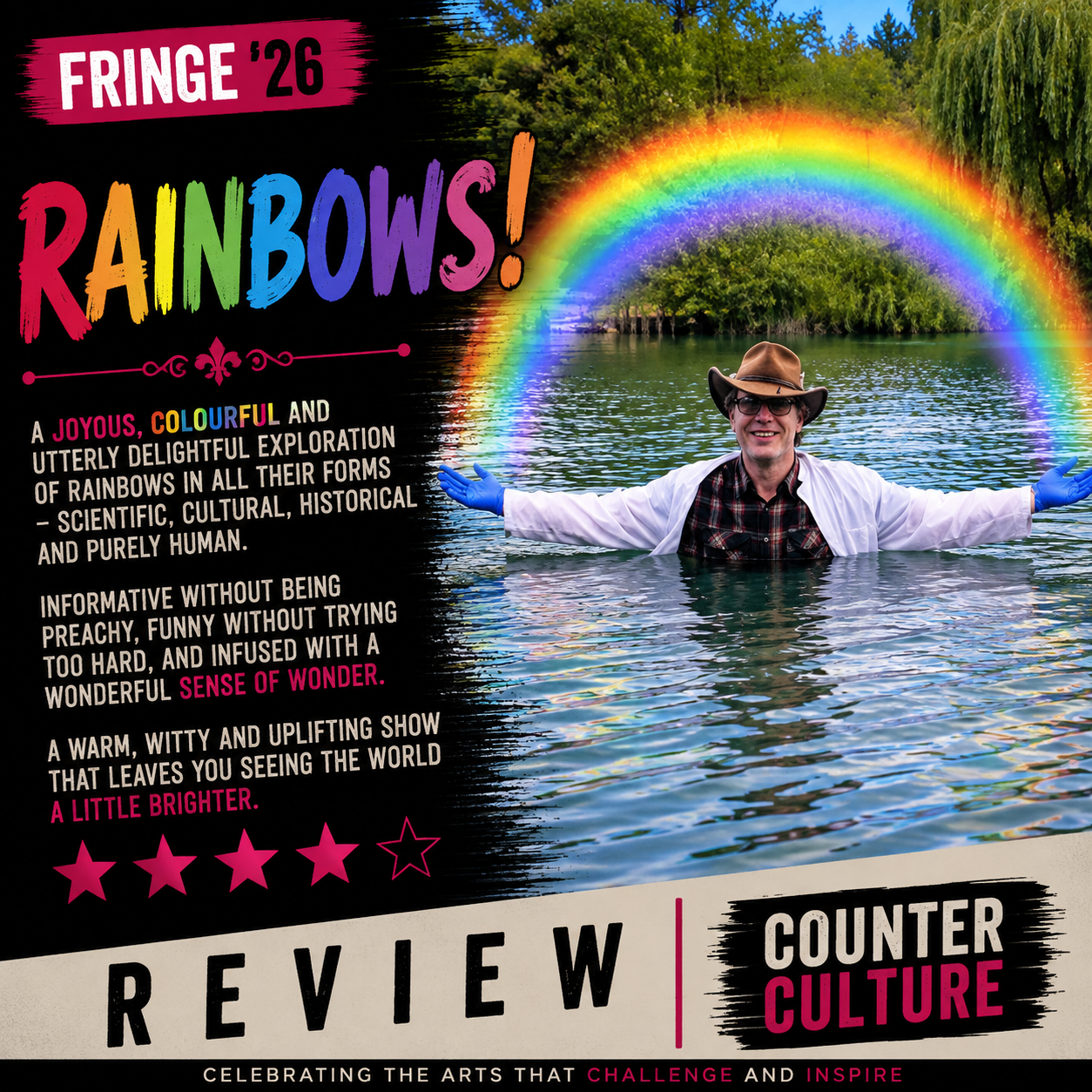
★★★★ There are Fringe shows that promise wonder, and then there are those that simply deliver it. Rainbows! sits firmly in the latter camp. Tim Clarkson, scientist, performer, and unabashed enthusiast for all things colourful, strides onto the stage with the easy confidence of someone who knows he’s about to surprise you.

What follows is a compact burst of curiosity and delight. Clarkson mixes chemicals with the precision of a seasoned researcher, yet presents each experiment with the warmth of a favourite teacher. Four different rainbow effects appear before our eyes—each one distinct, each one met with a ripple of disbelief from the audience. It’s not showmanship for its own sake; it’s science made visible, tangible, and unexpectedly beautiful.

There’s a gentle rhythm to the hour. After the fizz and glow of the chemical demonstrations, Clarkson shifts gears and brings out his rock collection. It’s an unexpectedly charming moment: a scientist sharing treasures like a child emptying their pockets after a day outdoors. He holds each specimen up to the light, revealing the subtle rainbow hues hidden in their mineral structures. The audience leans in, drawn by the quiet magic of colour emerging from stone.

The production is simple, but simplicity works in its favour. Clarkson and his assistant keep the pace brisk without rushing, allowing each experiment to land fully. Children watch with wide‑eyed fascination; adults smile at the clarity and joy of the explanations. It’s rare to find a Fringe show that genuinely suits all ages without compromise, but this one manages it with ease.

By the end, the room feels lighter—brightened not just by the colours on display, but by the sense of shared discovery. Clarkson’s enthusiasm is infectious, and his ability to make science feel playful is a gift.

Reviewed by Jacqueline Sharp

Comments (1)

The Umbrella Man: A Beautifully Crafted Reflection on Memory, Myth and History

Click on image to buy tickets

★★★★★ There is something quietly arresting about walking into a Fringe venue first thing in the morning and finding a single storyteller ready to guide you through one of the most scrutinised moments in modern history. Martin Fitzgerald stands alone onstage, but the world he unfolds is crowded with faces, fragments, and fleeting moments that have shaped how we remember the assassination of John F. Kennedy.

Rather than beginning with the spectacle of Main Street — the crowds, the noise, the pageantry — Fitzgerald leads us instead to the quieter corner of Dealey Plaza. It is here, among a small cluster of bystanders, that the stories he tells take root. His interest is not in the grand narrative of the assassination, but in the ordinary people who found themselves caught in its periphery and spent the rest of their lives unable to step out of its shadow.

He introduces us to the man with the umbrella, the woman with the Polaroid camera, the dressmaker who filmed the motorcade despite battling vertigo. Each figure is presented not as a puzzle to solve, but as a human being whose presence at that moment became part of the cultural imagination. Fitzgerald’s storytelling is brisk, clear, and deeply humane. He moves from one character to the next with a lightness that keeps the audience engaged while never trivialising the weight of the event.

There is humour woven throughout — gentle, observational, and perfectly timed. Fitzgerald understands that conspiracy theories can be both absurd and revealing, and he allows the audience to enjoy the strangeness without ever losing sight of the people at the centre of these myths. His tone is warm and restrained, inviting curiosity rather than feeding speculation.

What makes the production compelling is the balance he strikes between true‑crime intrigue and emotional insight. He explores how these bystanders shaped public understanding of the assassination, but also how the moment shaped them. Some became symbols, others vanished into anonymity, and all were changed by the brief seconds in which history swept past them.

The staging is simple, allowing the storytelling to take precedence. Visuals punctuate the narrative, offering glimpses of the individuals whose lives intersected with the event. Fitzgerald’s delivery is calm and assured, drawing the audience into the quiet corners of Dealey Plaza and the lives that unfolded there.

This adaptation of his recent book carries the same clarity and depth that critics have praised. It is smart, thoughtful, and unexpectedly moving — a reminder that history is often shaped not by those at the centre of the frame, but by those standing just outside it. Fitzgerald’s ability to illuminate the humanity behind the mythology makes this a standout piece of spoken‑word theatre at this year’s Fringe.

A quietly powerful, beautifully crafted production that lingers long after the final image fades.

Reviewed by Jacqueline Sharp

Click here to buy tickets


Leave a Comment

A Family Trade, a National Debate: Pierrepoint’s Life Condensed into One Hour of Compelling Theatre

Click on image to buy tickets

★★★★ Albert Pierrepoint remains one of the most unsettling yet compelling figures in British criminal history, and Pierrepoint: The People’s Hangman approaches him with a seriousness that suits the subject. Rather than sensationalising his work or turning him into a caricature of grim authority, Andrew Hogarth attempts something far more ambitious: it invites us to see the world through the executioner’s eyes.

Pierrepoint served as Britain’s principal hangman for roughly twenty‑five years, executing an estimated 435 people between the 1930s and 1950s. His career intersected with some of the most notorious murderers of the era — John Haigh, the Acid Bath Killer; Ruth Ellis, the last woman hanged in Britain; and John Reginald Christie of 10 Rillington Place, whose crimes form the backbone of this production.

The show’s strongest material lies in its treatment of Christie. Rather than presenting him simply as a monster, the production dissects his crimes with forensic clarity, exploring not only what he did but how he came to be standing on Pierrepoint’s trapdoor. Christie’s murders — committed in the suffocating confines of 10 Rillington Place — are examined with a clinical, unsettling intimacy. We see the bureaucratic machinery of justice grinding forward, and Pierrepoint positioned at its final, irreversible stage.

Professionalism, Precision, and a Missing Piece

One of the most compelling aspects of Pierrepoint’s life — and something the production hints at but never fully explores — is his almost mathematical approach to execution. He believed deeply in the dignity of his work and the necessity of performing it with precision.

Pierrepoint openly criticised the Americans for their botched hangings of Nazi war criminals after the Nuremberg trials. In his autobiography, he described their methods as clumsy, miscalculated, and needlessly cruel, with several condemned men taking far too long to die because the drop lengths were wrong.

This detail is not included in the production, but it would have enriched it enormously. It illustrates Pierrepoint’s broader philosophy: if the state is to take a life, it must do so swiftly, cleanly, and without unnecessary suffering. Including this would have given audiences a clear example of his professional ethos.

A Family Business

One of the surprises in the show — and a detail that many will not know — is that Pierrepoint came from a long line of executioners. His father Henry began in 1901, his uncle Thomas in 1906, and Albert himself took up the role in September 1932. This wasn’t a macabre calling; it was, in a very real sense, the family trade. The production handles this well, and it adds a fascinating layer to Pierrepoint’s character: he was stepping into a legacy as much as he was taking on a job.

The Challenge of a One‑Hour Biography

This is where the production struggles. A one‑hour Fringe slot is a notoriously tight container for a life as complex as Pierrepoint’s. Choices must be made about what to include and what to sacrifice. Here, the balance tilts too heavily toward the criminals he executed — Christie in particular — at the expense of exploring Pierrepoint’s own motivations, philosophies, and contradictions.

The result is a show that is fascinating, but not fully balanced. The narrative structure is clear, but the weighting of material feels slightly off. Pierrepoint’s inner world, his moral evolution, and his reflections on capital punishment deserve more space. That imbalance is the reason this review lands at four stars rather than five. The script simply needs fine‑tuning.

Potential, Audience Appetite, and the Ongoing Debate

The Fringe is the perfect environment for a show like this. Productions can evolve rapidly in response to audience and critical feedback, and this one has all the ingredients to become a truly exceptional piece. With some structural refinement, it could easily reach five‑star territory.

There is also a substantial audience for this kind of work. True crime has become a cultural phenomenon; dramatizations of cases like Ruth Ellis continue to draw viewers decades later. Pierrepoint himself is strangely under‑examined in modern media, despite his central role in some of the most infamous cases of the 20th century.

And, of course, the debate around capital punishment is far from settled. Today, support for the death penalty often comes not from belief in deterrence but from a visceral desire for retribution, particularly in cases involving children. The show touches on this, but could go further — and doing so would deepen its relevance.

Verdict

Pierrepoint: The People’s Hangman is a thought‑provoking, tightly performed, and quietly unsettling piece of theatre. It neither glorifies nor condemns Pierrepoint; instead, it presents the contradictions and lets them breathe. With a more balanced script — one that gives equal weight to the man and the crimes that defined his career — this could become one of the standout productions of the Fringe.

For now, it is a strong four‑star show, rich with potential and already one of the most intriguing pieces of the year.

Reviewed by Pat Harrington
Click here for tickets


Leave a Comment

Capturing the Light: A Family Story Rooted in Scotland’s Landscape

Click on image to buy ticket

★★★★★  Elsa McTaggart: Capturing the Light is a  piece that doesn’t simply recount a family story, but reanimates a lineage of Scottish creativity, history,  faith, and stubborn, rural resilience. Elsa McTaggart revisits the life of her great‑grandfather, landscape master William McTaggart, weaving faith, identity and rural Scottish heritage into a modern Fringe performance rooted in light and lineage.

What makes this production compelling is its refusal to treat William McTaggart as a museum figure. Elsa McTaggart approaches her great‑grandfather not as an icon, but as a man shaped by poverty, crofting, Gaelic culture, and the kind of hard graft that leaves its mark on every decision a person makes. The press material describes him as “the third‑born to Gaelic speaking Kintyre crofters” and someone who, through sheer determination, became “one of Scotland’s most popular and recognisable landscape artists.” That grounding matters. It frames the show not as nostalgia, but as an inquiry into how creativity emerges from constraint.

The production traces his journey from rural deprivation to the Trustees Academy School of Art in Edinburgh — a move he made at just sixteen. It’s here that he began exploring the gradations of light, a fascination that would define his work. But what the show captures beautifully is the tension between ambition and loyalty. Despite success, he stayed rooted in Scotland, loyal to the landscapes that shaped him. Many artists of his generation headed south, chasing London prestige. He didn’t. And Elsa treats that decision not as romantic mythmaking but as an act of conviction.

The spiritual dimension is where the piece becomes quietly profound. McTaggart’s upbringing in strict Presbyterianism — the kind of world where ministers scrutinise not just behaviour but intention — shaped him deeply. The show doesn’t shy away from the friction between institutional faith and personal spirituality. When the minister disapproved of his work, even visiting his Father, he didn’t abandon belief; he simply refused to let doctrine dictate his art. That moment, handled with restraint, reveals an independently minded man who saw painting not as rebellion but as devotion.

Elsa McTaggart

And this is where Elsa’s framing becomes genuinely moving. She suggests, implicitly that McTaggart’s art was a form of prayer. Not prayer as supplication, but prayer as attention — the act of looking closely at nature until it reveals something sacred. His seascapes, often devoid of figures or narrative, embody this. No ships. No drama. Just the sea as it is. The sea as he saw it. The sea as a kind of worship. He had a lifelong fascination with light; Elsa shows us why that mattered. Light, for McTaggart, wasn’t just technique. It was theology.

The show itself blends storytelling, music, and projection. Although at the show I was at technical glitches knocked out the projection forcing me to concerntrate on just the narration and music.  Elsa and her long‑time collaborator Gary Lister have been performing other sold‑out Fringe shows for fifteen years, and that experience shows. The musical sections — each inspired by the titles of McTaggart’s paintings — are warm, confident, and rooted in Hebridean sensibility. The production design by Robbie Thomson gives the piece a visual clarity that mirrors McTaggart’s own obsession with light. And the involvement of Isle of Lewis arts venue An Lanntair, along with sruth‑mara’s track record of thoughtful, community‑rooted work, gives the show a sense of place that feels earned rather than decorative.

What emerges is not a biographical lecture, nor a family tribute, but a meditation on legacy — how creativity travels through generations, how rural identity shapes artistic instinct, and how faith can be both anchor and burden. Elsa isn’t simply telling us who her great‑grandfather was; she’s showing us how his way of seeing the world shaped her own.

By the end, you understand that McTaggart didn’t paint to escape his circumstances. He painted to honour them. And Elsa, in turn, honours him not by mythologising his life, but by illuminating the quiet, spiritual labour at its core.

A thoughtful, lyrical, and deeply Scottish piece of theatre — one that treats art not as spectacle, but as inheritance.

Reviewed by Pat Harrington

Click here for tickets

Leave a Comment

The Love You Take: A Gentle, Insightful Portrait of Mae Axton

Click on image to buy tickets

⭐️⭐️⭐️⭐️ Cory Dagg has had the kind of career most actors only dream about. He spent years in Hollywood, appearing in The X‑Files and The Commish, and sharing scenes with Robert De Niro in We’re No Angels. There were other films too — Wrongfully Accused among them — the sort of steady, recognisable work that quietly builds a life in the industry. But here, at the Fringe, he stands alone onstage with nothing more than a slide projector and a story he promised he would “tell, and tell right.”

The show centres on a chance meeting that changed him: an evening spent with Mae Axton, the American songwriter, teacher, publicist and part‑time radio DJ whose fingerprints are all over the early career of Elvis Presley. Cory recalls being introduced to her by her son, Hoyt Axton, and from there the night unfolded into one of those encounters that stays with you. Onstage, he lets Mae speak again — through her words, her work, and the images he projects behind him.

What emerges is a portrait of a woman who was far more than the co‑writer of “Heartbreak Hotel.” Cory explains how Mae and Tommy Durden shaped the song from a bleak newspaper clipping into something sharper, stranger, and unforgettable. He describes how she handed Elvis the demo, how he recorded it, and how it became his first million‑selling RCA single. More importantly, he shows how Mae championed Elvis long before Colonel Parker took over — interviewing him on her radio show, pushing for him, believing in him.

The slides, the voiceover, the quiet pacing — they all serve the same purpose: to honour Mae Axton as the “queen mother of Nashville,” a pioneer who wrote more than 200 songs and worked with Willie Nelson, Tanya Tucker, Mel Tillis, Reba McEntire and so many others. Cory’s pact with her — to tell the story properly — gives the show its heart. It’s respectful, insightful and gently illuminating, the kind of Fringe hour that sends you away wanting to know more.

For anyone curious about the early, fragile years of Elvis Presley, or about the woman who helped steer him towards history, this is a thoughtful and affectionate tribute.

Reviewed by Jacqueline Sharp

Click here to buy ticket

Advert

Leave a Comment

Paris in a Jazz Age Captures the Smoke, Swing and Soul of 1920s Paris

Click on image to buy tickets

 Some Fringe shows try to recreate an era with props and posture. Paris in a Jazz Age does it with mood. From the moment Airlie Scott steps into the light as Eloise DeFleur, you feel the room tilt gently toward 1920s Paris and on — that heady mix of smoke, swing, and possibility. It’s not a history lecture. It’s a feeling. And the show gets that feeling right.

Airlie has an easy command of the space. She doesn’t force the character; she lets Eloise arrive naturally, as if she’s been living in the wings for decades and has finally decided to wander out and talk. There’s a warmth to her storytelling, a softness in the way she lets memories unfold. Nothing rushed. Nothing over‑played. Just a woman looking back at the city that shaped her.

The music is where the show really breathes. The Hot Jazz Vagabonds are the real thing — proper hot‑club swing, the kind of nimble, conversational playing that makes you sit up a little straighter. Alan Gibson’s bass keeps everything steady; David Ahmed and Andy Ruiz Palma’s guitars dance around each other with that unmistakable Django shimmer; Pete Watson’s accordion folds the whole sound in Parisian colour. It’s a band that knows exactly what it’s doing.

One of the highlights for me was “Blue Skies”, a Josephine Baker song from 1937. It’s one of my favourite vocal jazz numbers anyway, but Airlie gives it a lovely lift — bright, hopeful, almost conspiratorial. You can hear the optimism of early‑20s Paris in the way she phrases it, that sense of a city opening its arms to anyone bold enough to step inside.

The show also touches on songs that speak directly to the city itself — pieces like “I Love Paris”, which fits the tone perfectly. It’s one of those numbers that carries the whole sweep of the place in a few bars: the romance, the melancholy, the sense that the city is always slightly larger than your own life. Hearing it in this context feels right. It’s not just a standard; it’s a love letter folded into the set.

The rest of the repertoire moves through the music that defined the era: gypsy jazz standards, early swing, touches of French chanson, and those American Songbook classics that drifted across the Atlantic and settled into the clubs. Airlie has spoken about building the show around songs she loves from those traditions, and you can feel that affection. Nothing feels like filler. Every number earns its place.

What gives the show its shape is the memoir framing — Eloise arriving in Paris in 1920, finding her voice, losing people she loved, watching the city change under Occupation, and carrying on because that’s what Paris demanded. It’s lightly handled, never heavy, but it gives the music emotional weight. A song isn’t just a song; it’s a chapter.

There’s a moment, late in the show, where Airlie shifts from glamour to something quieter. It’s subtle, but it lands. You realise you’ve been listening not just to a performer but to a woman who has lived through joy and uncertainty and still finds reasons to sing. That’s the heart of the piece.

By the end, you feel you’ve spent an hour in Paris — not the postcard version, but the one built from late‑night cafés, warm laughter, and songs that stay with you. It’s a lovely thing to walk out of Surgeons’ Hall with.

Reviewed by Pat Harrington

Click here for tickets

Read our interview with Airlie  Scott here

Advert

Leave a Comment

The Last Bantam: A Powerful Revival of Ireland’s Forgotten WWI Soldiers

Click on image to buy tickets

★★★★★ To a background of constant shelling noises, we meet Patrick Michael Wolfe, a corporal in the 15th Bantam Battalion of the Notts and Derby Regiment of the British Army. Patrick wasn’t conscripted; he volunteered – at first in his hometown of Dublin, and then in England – but rejected as he didn’t meet the minimum 5ft 3in height requirement.

In Derby, however, he enlisted in the Bantam Battalion. He didn’t join up for the money. Patrick signed up to get Home Rule for Ireland. His comrade, Belfast Billy, a shipyard man joined up to stop it as he thought Home Rule for Ireland meant Rome Rule. Billy, Patrick recalls, was a brave man, the best sergeant he ever had. Despite their political differences, they forged a true comradeship in the trenches of the Western Front.

Michael Hughes, the writer and performer of this powerful play, unearths the hidden history of the forgotten soldiers of the First World War, men who were from five feet tall to those who were five feet, three inches in height. His character tells the story of how they were treated by friend and foe alike; they were given cast-off Boer War or Post Office blue uniforms, issued with ill-fitting boots, catcalled in the street and mocked and jeered as ‘petit soldat’ by the French.

Patrick brings home the grim reality of life and death in the trenches of the Western Front, constant shelling, German snipers, gas attacks, scouting raids, hand-to-hand combat, and his spell in hospital after suffering a wound where he witnesses men go into the operating theatre with two legs coming out with one, none or not coming out at all. The attrition grinds down the battalion. Of the thousand men who joined, only Patrick is left, so the numbers were replenished by men of regular height as most shorter men were unfit for service.

Patrick felt a keen sense of betrayal when news broke of the ‘rebellion in Dublin two years ago in Easter 1916’ – what we know today as the ‘Easter Rising’ – when ‘rebels with German rifles’ declared a Republic. ‘Why,’ he wanted to know, ‘were’t they here with us?’  Dublin was in flames. ‘Our lads fought the rebels and formed firing squads to shoot the ringleaders.’ Wistfully, he says, ‘I wish I didn’t know that.’

The Last Bantam brings home to a modern audience the brutal reality of trench warfare, the survival skills necessary, and the camaraderie that emerges between the men in the middle of the blood and the mud and the constant shelling. It puts a spotlight on the often-contradictory motivations of the men who served, especially those from Ireland.

History has been kind to the Dublin insurrections of 1916 and the Ulstermen of the 36th (Ulster) Division. Not so, the tens of thousands of Irishmen who served in the British Army in that conflict. Until recently, they were regarded at best as a national embarrassment. This play will help redress the balance. It deserves a wider audience.

Reviewed by David Kerr

Click here to buy tickets

See the interview with Michael Hughes here


Leave a Comment

A Dark Line Upstairs – Matilde Vigna’s Stark, Moving Monologue on the 1951 Polesine Floods

Click on image to buy tickets

★★★★ Matilde Vigna gives a stark account of devastating floods of biblical proportions that hit Polesine in north-eastern Italy in 1951. A long summer of droughts ended with unceasing rain in the autumn. Flood waters rose to unprecedented levels. Villages were evacuated. Elderly people were swept away.

Switching characters through her tone and a clever use of lighting, Vigna contrasts this disastrous period with her life seven decades on. In a happier and more bubbly tone, she confides that she’s an expert on packing. She lives out of a suitcase by choice. Her moves from place to place are intentional. But she asks, how do you pack a ‘Goodbye Forever’ suitcase when disaster strikes? What do you keep? What do you abandon? What are your priorities when your survival is at stake?

This compelling monologue forces you to think about the vicissitudes of our lives. Life can be more precarious than we think. In 1951, Vigna says, we all believed that we had a firm grip on things. We believed that we were in control of our own lives. We didn’t see the storm clouds approaching. Would we fair any better if the waters rose to leave a lingering dark line on our walls?

Reviewed by David Kerr

Click here to buy tickets

Leave a Comment

In Conversation with Chris Brookmyre and Marisa Haetzman

★★★★★ Chris Brookmyre and Marisa Haetzman make a compelling double act — warm, funny, and deeply knowledgeable — and their conversation at The Stand offered a vivid look into how two very different professional worlds combine to create the Ambrose Parry novels. What emerges is not just a discussion about writing, but a portrait of a partnership built on curiosity, respect and shared fascination with Edinburgh’s medical past.

They began by talking about their joint pseudonym, Ambrose Parry, and the decision to write under a single name. Haetzman spoke candidly about the challenge of learning to write fiction from scratch, especially alongside Brookmyre, whose crime novels — including the Jack Parlabane series — have shaped Scottish genre writing for decades. Their reflections on blending voices, negotiating differences, and discovering a collaborative rhythm were honest and often very funny.

Haetzman’s background as a consultant anaesthetist, and her extensive research for her Master’s degree in the history of medicine, form the backbone of the Ambrose Parry world. Brookmyre described how her academic work captivated him, ultimately inspiring the pair to set their novels amid the medical innovations and moral complexities of 18th‑century Edinburgh. Their first book, The Way of All Flesh, appeared in 2018; their most recent, The Death of Shame, was published in mid‑2025. The series now includes five main novels and two digital novellas.

One of the highlights was their discussion of Dr Will Raven and his mentor, the pioneering obstetrician Dr James Young Simpson. Their anecdotes about Simpson’s early chloroform experiments — including its use at dinner parties — drew delighted laughter from the audience, illustrating the strange blend of danger, discovery and social eccentricity that fuels their fiction.

Brookmyre touched briefly on his solo work, offering sharp insights into his writing style and how it shifts when working within the Ambrose Parry framework. But the real pleasure of the event lay in the interplay between the two of them: Haetzman’s precision and historical depth paired with Brookmyre’s wit and narrative instinct.

This was an engaging, warm‑spirited hour with two writers who clearly love their craft and each other’s company. The audience responded in kind, enjoying a conversation that was as charming as it was informative.

A thoroughly enjoyable event — one that deserves to be repeated.

Reviewed by Jacqueline Sharp

Leave a Comment