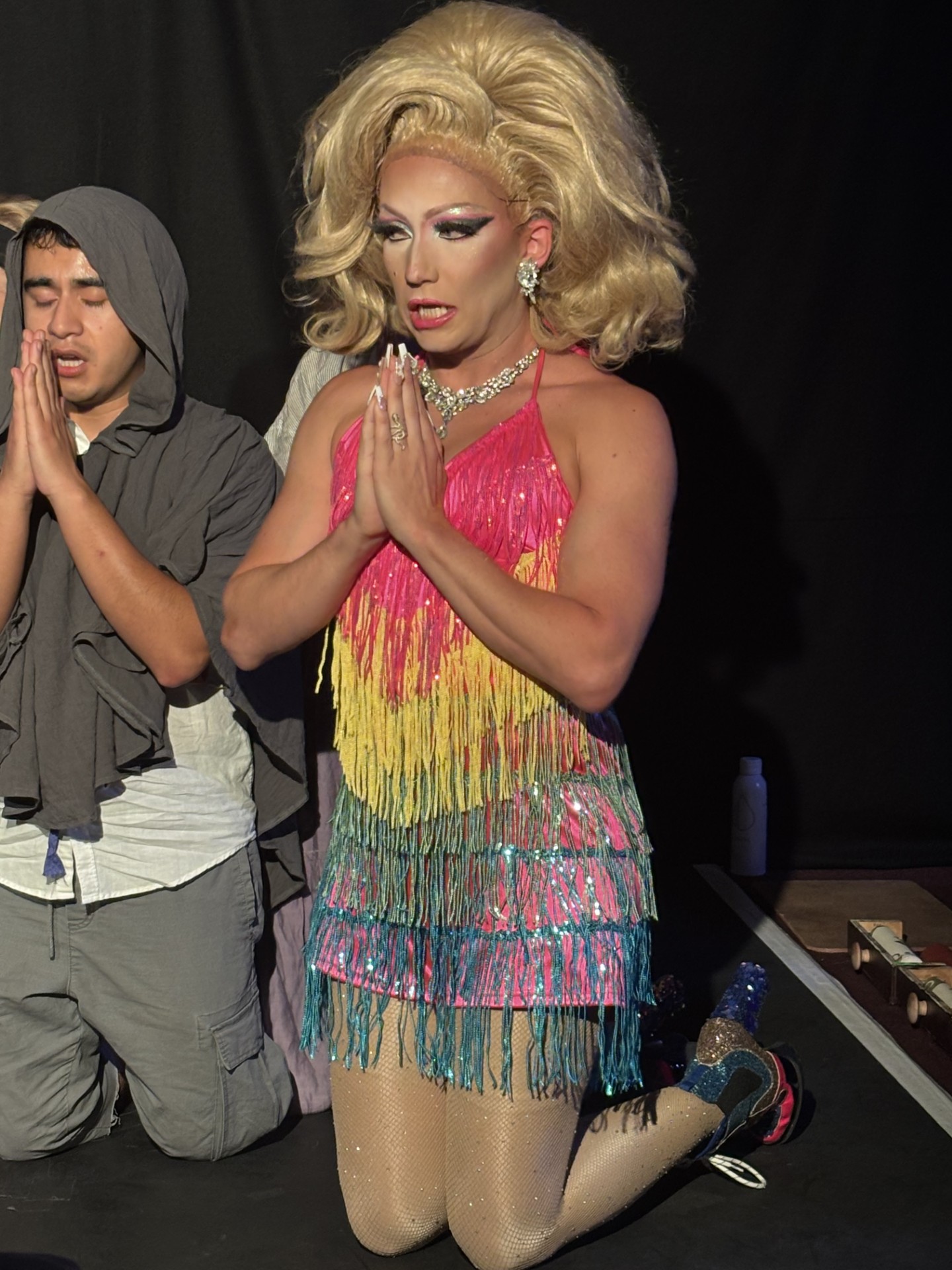
For 1518: The Dancing Plague,playwright‑director‑producer Hannah Ponturo doesn’t just revisit a medieval hysteria — she queers it from the inside out. At the centre of Strasbourg’s civic collapse she places Katherine and Anna, two women whose long‑fractured romance becomes the emotional pulse of a society losing its grip. Ponturo treats queerness not as an add‑on but as the lens through which the crisis sharpens: desire as defiance, intimacy as resistance, love as the one human truth that refuses to behave, even when the world is convulsing around it.
Her production moves between satire, tenderness, and outright absurdity, but the queer heart of the piece never wavers. In a story about bodies pushed past their limits, she insists on showing what happens when two people try to reclaim their humanity in a society determined to deny it. The result is a work that feels both ancient and urgently contemporary — a queer love story beating beneath the noise of mass panic, political failure, and the strange comfort of collective delirium. We asked her to tell us more…
1. What does it mean to centre a queer love story between Katherine and Anna in the middle of a medieval mass‑hysteria crisis — is love the antidote, or just another form of delirium?
Neither. Love is a human need but it can’t save us from either ourselves or outside forces.
2. Why does a 500‑year‑old dancing plague feel more recognisable than anything we lived through in 2020?
Writing this piece post covid allowed me to accidentally draw parallels without initially intending to. Once it was clear, I wanted to channel Arthur Miller a la The Crucible and write about a historical crisis that was really about a modern event.
3. The clergy and city authorities scramble to contain the outbreak — is the real satire aimed at how power behaves when it loses control?
Yes, the clergy and city authorities get a hard beating from me throughout the show. Ultimately people who hold power are just people and during a crisis it’s very difficult to make the decision that will be deemed “right” in hindsight. Nevertheless some choices were so obviously wrong in the moment.
4. What’s the moment where the audience realises the comedy is getting uncomfortably close to our own recent chaos?
It sneaks up on you naturally until you start to realize that one plague is not so different from the other.
5. Does the play treat hysteria as a disease, or as something society manufactures when it can’t face the truth?
A little bit of both. The characters within the play truly believe that it’s a disease while I hope to portray that it’s the latter.
6. Katherine and Anna’s “long‑fractured romance” reignites while Strasbourg collapses — is queer love the rebellion here?
Queer love and fighting for one’s humanity is the rebellion.
7. How much of the dancing is pure comedy, and how much is a metaphor for people being pushed past their limits?
There’s only a small portion of the dancing that’s actually comedy. Our choreographer, Sydney Diamond, has created a language for the dancing sickness using the four elements: air, fire, water, earth. At first the dancing is air. These people are living in an enormously oppressive society and being able to dance feels good. Then, it becomes fire and the energy is full of sparks until we get to water and it becomes heavy. Ultimately earth is our destination before death.
8. What’s the most outrageous moment in the show that audiences absolutely won’t see coming?
Come and see!
9. How does the production balance the absurdity of people dancing themselves to death with the tenderness of a queer love story?
The incredible actors are able to balance this flawlessly: Britney Shields, Nicole Souza, Ryabrae Ngaida, Tallulah Jones, Gilberto Ortiz, Anne Marie Howard, and Don Berman.
10. Does the play suggest that crises bring people together, or that they expose what was broken all along?
Perhaps both. I’m sorry for being so Switzerland in this interview but I really do believe that there’s not just one answer to anything (except math, which I’m bad at).
11. What single image from the show captures both the comedy and the horror of the dancing plague?
Our logo, designed by Max DiRado, is the perfect image to describe our show. It’s a modern girl twerking with the medieval doctor plague mask on. I LOVE it.
12. If the dancing plague happened today, would it start on TikTok — or would TikTok just monetise it?
I think both. Today, anything that can be monetized will be.
13. How does the show use satire to talk about modern crises without ever naming them outright?
Bad government, heightened emotions, and incorrect medical advice are sadly timeless.
14. What do you hope queer audiences take from Katherine and Anna’s story that straight audiences might miss?
There’s a raw vulnerability to their love that I hope everyone can see, relate to, and experience either now, in the future, or in the past.
15. Why does a medieval dance‑till‑you‑drop epidemic feel like the perfect metaphor for the way we cope with uncertainty now?
The Dancing Plague is inherently silly and disarming so I hope to use this as a way to bring people in before getting to the subjects that may be less palatable.
Find out more and buy tickets
hereAdvert