Posts Tagged TheSpaceUK

1518: The Dancing Plague — Satire, Chaos and Queer Heart at the Fringe

Click on image to buy tickets

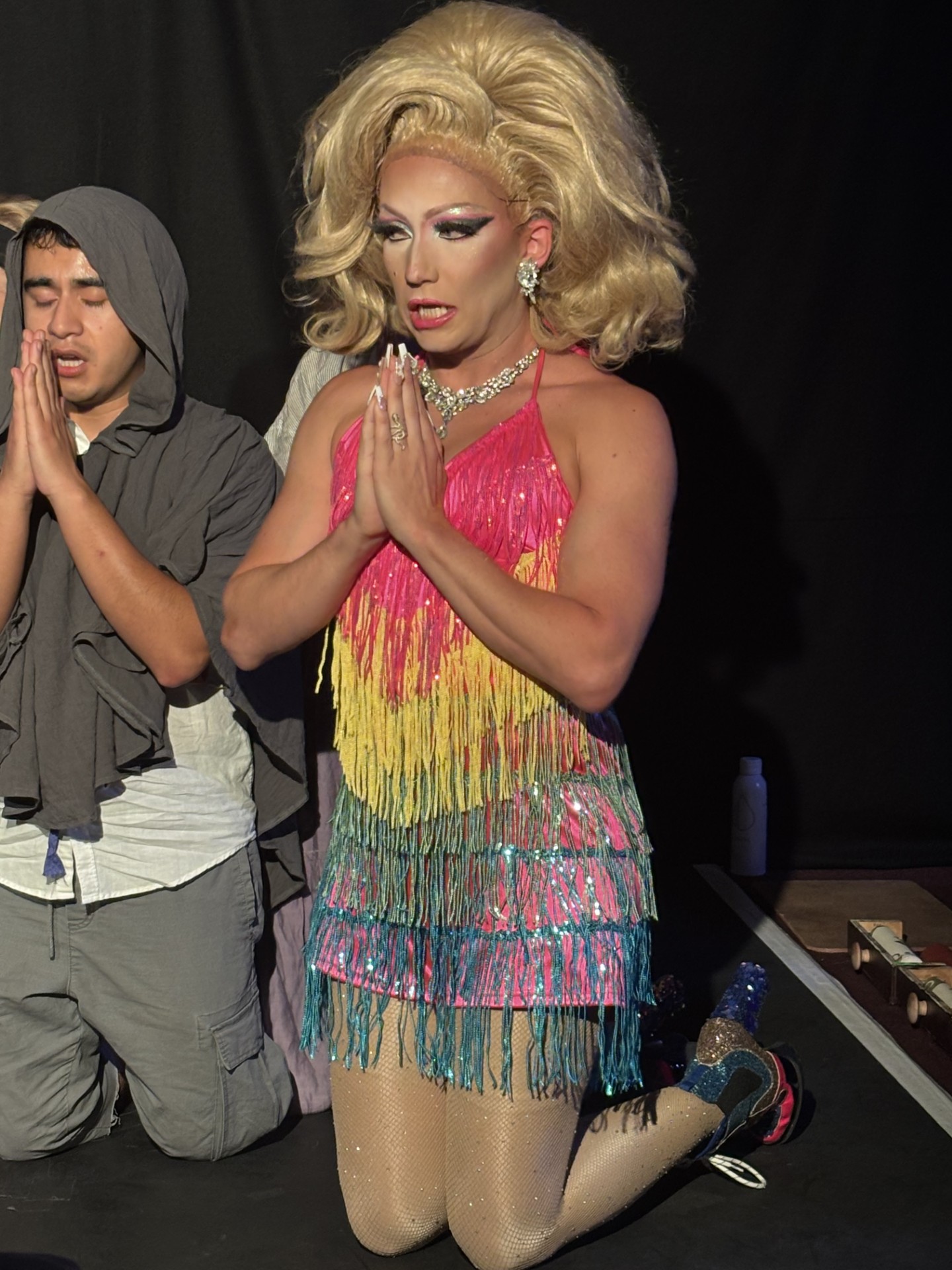
★★★★★There’s something deliciously Fringe about a show that invites you to “shake your a** and dance ’til you (hopefully don’t!) die,” and 1518: The Dancing Plague leans into that promise with full satirical commitment. Based on the very real medieval mass hysteria that had Strasbourg’s citizens dancing themselves into oblivion, Hannah Ponturo’s comedy arrives at theSpaceUK fresh from Los Angeles—armed with a sold‑out reading, a Daredevil Festival pedigree, and the kind of chaotic energy that thrives in late‑night Edinburgh.

At its heart is a queer romance between Katherine and Anna, two peasants whose long‑fractured relationship reignites just as the city collapses around them. It’s a smart dramatic anchor: while clergy and civic authorities scramble to contain the outbreak, the play keeps circling back to the human impulse to connect even when the world is wobbling off its axis. The production promised “uncanny parallels” to our own recent crises, and the show doesn’t shy away from them—Covid echoes, political absurdity, and the familiar spectacle of institutions panicking while ordinary people try to make sense of the mess.

We loved the drag devil/angel narrator

Ponturo’s writing has that LA‑meets‑NYC flavour: punchy, self‑aware, and unafraid of silliness as a delivery system for something sharper. The production, created with Open Variations Theater, fits neatly into their mission of reimagining lesser‑known stories with contemporary bite. You can feel the interdisciplinary New York influence in the way the piece layers satire, history, and outright party vibes into a single 50‑minute burst.

And yes, it is a dance party. The show wants you complicit in the hysteria—laughing at it, recognising it, maybe even feeling the tug of it. The absurdity of people dancing themselves to death becomes a mirror held up to the way we cope with uncertainty now: distraction as survival, movement as denial, rhythm as rebellion.

It’s messy, cheeky, knowingly ridiculous, and unexpectedly tender. Exactly the sort of Fringe show that sneaks up on you: you arrive for the chaos, and leave thinking about the systems that shape how we behave when everything goes sideways.

If you’re looking for a satire with historical weirdness, queer heart, and a healthy disrespect for authority, 1518: The Dancing Plague earns its place on your August shortlist.

Reviewed by Pat Harrington

Click here for tickets

Leave a Comment

Body Parts: A Simple, Human Story of Repairing What’s Broken

Click on image to buy tickets

★★★★★  Body Parts is a small, honest, and quietly powerful Fringe show about a family trying to rebuild itself after a loss. A mother travels to rural Scotland, alongside one daughter, to visit another daughter who has bought a rundown house with her inheritance. The house is falling apart, and so are the relationships inside it. That’s the heart of the piece: people trying to fix things when they’re not sure how.

The story centres on four characters who are all dealing with their own turning points. Carmel is determined to make a fresh start, even if the house she’s chosen is barely standing. Margot tries to support her, though she sees the cracks clearly. Russell, Carmel’s on‑off boyfriend, is stuck between wanting to help and not knowing where he fits. And May, the mother, watches all of this with a mixture of worry, affection, and a growing sense of her own needs.

One of the strongest parts of the show is how it handles self‑acceptance. There’s a moment where May asks to be photographed so she can draw herself honestly. It’s simple, but it says a lot about how she’s trying to see herself again after years of putting everyone else first. Her relationship with her daughters also has real depth, especially with Margot, who has converted to Islam. It’s treated with respect and adds an additional, natural cultural layer to the family dynamic.

The show also uses physical theatre in a way that feels grounded rather than gimmicky. A scene where the women crawl across the floor stands out — it’s a clear picture of how stuck they all are, and how hard they’re trying to move forward.

The writing feels real. You can tell it’s been shaped by personal experience. The conversations sound like things families actually say when they’re tired, frustrated, or trying their best. The show asks a good question: what do you need when you’ve run out of wanting? It doesn’t force an answer, but it gives you plenty to think about.

There’s also some clever use of technology — facial‑mapping, sound, and projection — but it never takes over. It supports the story rather than showing off. That’s rare at the Fringe, and it’s done well here.

The cast work strongly as an ensemble. They play the tensions and the small moments of connection with a natural ease. Nothing feels exaggerated or over‑acted.

Body Parts is a thoughtful, well‑performed piece about ageing, faith, self‑worth, and the messy ways families try to support each other. It’s simple, human, and quietly moving. And it leaves you wanting to see what this writer does next.

Reviewed by Pat Harrington

Click here for tickets


Leave a Comment

00:45:00 – Five Walk In. One Walk Out. The Audience Decides.

Five people walk into a room, and only one will make it out alive. The clock is running, the rules are brutal, and the audience isn’t allowed to sit comfortably in the dark.

This is a real‑time experiment led by a scientist who wants to know whether one person’s life can ever be worth more than another’s — and what happens when ordinary people are pushed to make that decision. It’s a story about spectators who discover they’re participants, about the moment when watching becomes acting, and about the uncomfortable truth that complicity is rarely abstract.

The playwright behind 00:45:00, Katie Gaven, understands that moral pressure isn’t a gimmick — it’s a provocation. Here, she talks about how the idea formed, why she wants audiences to feel implicated, and how the show has transformed on its journey to the Edinburgh Fringe.

When did the premise of five people entering a room and only one leaving stop being a dramatic device and start becoming a moral experiment you wanted to run on an audience?

The dramatic premise came to me pretty quickly once I knew I wanted to write a psychological thriller, and the decision to turn it into a social or moral experiment developed hand in hand with that. I’ve always loved the horror genre, especially psychological horror, and a lot of the material that inspired me was told through digital mediums — Alice in Borderland, Black Mirror, Squid Game.

That made me ask myself: if I’m going to work in this genre, why tell it through live theatre? The thing I love most about theatre is the way it connects people. So it made sense that the experiment should involve the audience directly.

The show asks whether one life can ever be “worth more” than another. Do you see that as a provocation, or as a question we all quietly answer every day without admitting it.

Honestly, I think it can be both. Weighing one life against another is not something we like to think about day to day. Putting people in that spot is tricky — you can lose the trust of an audience if you mishandle it.

But I also believe one of our best human qualities is empathy, the kind that ignites us to fight and advocate for others. That’s what I wanted to experiment with. It’s a question I’ve asked our audiences to think about, and I hope we can all try to make sense of it together.

Immersive theatre often lets audiences hide behind the novelty of participation. You seem to be doing the opposite — forcing them to confront complicity. What made you want to push them into that uncomfortable territory.

It’s a hard balance, and I’m still figuring it out. One of the main things I’m discovering through new drafts and conversations is that there’s actually positivity in acknowledging complicity. When we treat that acknowledgment as a victory — a step in the right direction — it becomes easier to inspire ourselves and others to do more.

Complicity is difficult to reckon with in everyday life. I think it’s good to be reminded of it, prodded to engage with it. It’s something I’m still unpacking within myself.


You explore corruption of power and the temptation to look away from injustice. Were there particular moments — political, personal, global — that made you realise this was the story you needed to tell now.

There are so many things that factored into it. The world feels full of terrifying injustices, and while media can be a tool, it can also be desensitizing. We see horrible acts of violence and political injustice every day, and I often feel horrible but also powerless — unsure how I can personally make a difference.

I consider myself privileged, and I never want that to become an excuse to disengage. I feel desperate to actively engage in these conversations and hold myself accountable. This play is an attempt at searching for that action.

The piece was first produced at UNCSA and is now leaping to the Fringe. How has the show changed as it moved from a university environment to an international stage.

OMG it has changed so. freaking. much. We did our first production at my university in a very controlled environment, got incredibly helpful feedback, and were insanely fortunate to be supported by the Thomas S. Kenan Institute for the Arts and fiscally sponsored by Producer Hub.

The play has gone through new drafts, more audience feedback, and a total transformation thanks to the financial support that allowed us to collaborate with amazing artists — our publicist Rosaline Hodgetts, lighting designer Miles Goldsmith, and many more. I can’t wait to share what we’ve been working on.

You’re a six‑time published playwright with recognition from Scholastics, The Blank Theatre, and California Young Playwrights. Does 00:45:00 feel like a continuation of your earlier work, or a rupture — a new artistic chapter.

This is definitely a new artistic chapter. Believe it or not, I’m mostly known as a comedic writer, so working on this play has been a new and vulnerable experience. I’ve never been so scared or excited for a play before. Experimenting with this genre has taught me so much, and I’m excited to see how it influences me as an actor, writer, and director.

Audience participation can be gimmicky if mishandled. How do you ensure the involvement here isn’t a trick, but a genuine ethical pressure point.

For us, it’s important to keep our end goal in mind. If we believe the audience participation is important and impactful, the audience will believe that too.

We’re specific about what success looks like for each character so we understand how participation affects their journey. Most interaction is between the audience and Dr. Wilison, so establishing her objective from the moment she welcomes the audience is crucial. Every bit of participation gets her closer to her goal, and treating those interactions as integral makes them feel genuine.

The show is supported by the Kenan Institute and fiscally sponsored by Producer Hub. Did that backing give you freedom, or sharpen your sense of responsibility.

It definitely sharpened our sense of responsibility. This has been a huge learning experience in balancing collaboration, and I’m beyond grateful for the opportunity.

There’s no way we could’ve done this without the financial support and collaboration from the Kenan Institute and Producer Hub. Getting new work onto the stage is a huge challenge, and for most young playwrights it would be impossible without this kind of help. We feel unbelievably lucky and are doing everything we can to make them proud.

Your cast comes from varied backgrounds — film, theatre, dance, visual art. How did those different artistic languages shape the tension inside the room.

It helps that we all come from the same training program, so we share the same acting vocabulary. I’m an actress first and then a writer, so connecting with the cast as a director through familiar techniques has been great.

At the same time, being multifaceted artists helps us collaborate. Each person brings unique skills. Our best days are when we embrace our different approaches and use them intentionally to build a cohesive world.

Fringe audiences are famously game for risk, but they’re also saturated with choice. What do you hope they walk out carrying — adrenaline, discomfort, clarity, or simply a question they can’t un‑ask.

Absolutely a question they can’t un‑ask. I want this to spark conversation. I don’t know the answers to the questions I’m asking — I want to learn through others.

I also hope to inspire actionable activism instead of passivity. I wrote this play because I’m still unsure how to create change, but I believe the first step is recognizing you want to get involved and engaging in conversations to figure out how.

We hope people interested in those discussions will come see us at the Edinburgh Fringe Festival — August 17–22 at thespaceUK @ Surgeon’s Hall (Stephenson Theatre) and August 24–28 at thespaceUK @ Venue 45. Join us for an experiment you won’t forget.

Buy tickets here


Leave a Comment

Desire, Delirium and Defiance: Hannah Ponturo Reimagines Strasbourg’s Dancing Plague

For 1518: The Dancing Plague,playwright‑director‑producer Hannah Ponturo doesn’t just revisit a medieval hysteria — she queers it from the inside out. At the centre of Strasbourg’s civic collapse she places Katherine and Anna, two women whose long‑fractured romance becomes the emotional pulse of a society losing its grip. Ponturo treats queerness not as an add‑on but as the lens through which the crisis sharpens: desire as defiance, intimacy as resistance, love as the one human truth that refuses to behave, even when the world is convulsing around it.

Her production moves between satire, tenderness, and outright absurdity, but the queer heart of the piece never wavers. In a story about bodies pushed past their limits, she insists on showing what happens when two people try to reclaim their humanity in a society determined to deny it. The result is a work that feels both ancient and urgently contemporary — a queer love story beating beneath the noise of mass panic, political failure, and the strange comfort of collective delirium. We asked her to tell us more…


1. What does it mean to centre a queer love story between Katherine and Anna in the middle of a medieval mass‑hysteria crisis — is love the antidote, or just another form of delirium?

Neither. Love is a human need but it can’t save us from either ourselves or outside forces.

2. Why does a 500‑year‑old dancing plague feel more recognisable than anything we lived through in 2020?

Writing this piece post covid allowed me to accidentally draw parallels without initially intending to. Once it was clear, I wanted to channel Arthur Miller a la The Crucible and write about a historical crisis that was really about a modern event.

3. The clergy and city authorities scramble to contain the outbreak — is the real satire aimed at how power behaves when it loses control?

Yes, the clergy and city authorities get a hard beating from me throughout the show. Ultimately people who hold power are just people and during a crisis it’s very difficult to make the decision that will be deemed “right” in hindsight. Nevertheless some choices were so obviously wrong in the moment.

4. What’s the moment where the audience realises the comedy is getting uncomfortably close to our own recent chaos?

It sneaks up on you naturally until you start to realize that one plague is not so different from the other.

5. Does the play treat hysteria as a disease, or as something society manufactures when it can’t face the truth?

A little bit of both. The characters within the play truly believe that it’s a disease while I hope to portray that it’s the latter.

6. Katherine and Anna’s “long‑fractured romance” reignites while Strasbourg collapses — is queer love the rebellion here?

Queer love and fighting for one’s humanity is the rebellion.

7. How much of the dancing is pure comedy, and how much is a metaphor for people being pushed past their limits?

There’s only a small portion of the dancing that’s actually comedy. Our choreographer, Sydney Diamond, has created a language for the dancing sickness using the four elements: air, fire, water, earth. At first the dancing is air. These people are living in an enormously oppressive society and being able to dance feels good. Then, it becomes fire and the energy is full of sparks until we get to water and it becomes heavy. Ultimately earth is our destination before death.

8. What’s the most outrageous moment in the show that audiences absolutely won’t see coming?

Come and see!

9. How does the production balance the absurdity of people dancing themselves to death with the tenderness of a queer love story?

The incredible actors are able to balance this flawlessly: Britney Shields, Nicole Souza, Ryabrae Ngaida, Tallulah Jones, Gilberto Ortiz, Anne Marie Howard, and Don Berman.

10. Does the play suggest that crises bring people together, or that they expose what was broken all along?

Perhaps both. I’m sorry for being so Switzerland in this interview but I really do believe that there’s not just one answer to anything (except math, which I’m bad at).

11. What single image from the show captures both the comedy and the horror of the dancing plague?

Our logo, designed by Max DiRado, is the perfect image to describe our show. It’s a modern girl twerking with the medieval doctor plague mask on. I LOVE it.

12. If the dancing plague happened today, would it start on TikTok — or would TikTok just monetise it?

I think both. Today, anything that can be monetized will be.

13. How does the show use satire to talk about modern crises without ever naming them outright?

Bad government, heightened emotions, and incorrect medical advice are sadly timeless.

14. What do you hope queer audiences take from Katherine and Anna’s story that straight audiences might miss?

There’s a raw vulnerability to their love that I hope everyone can see, relate to, and experience either now, in the future, or in the past.

15. Why does a medieval dance‑till‑you‑drop epidemic feel like the perfect metaphor for the way we cope with uncertainty now?

The Dancing Plague is inherently silly and disarming so I hope to use this as a way to bring people in before getting to the subjects that may be less palatable.

Find out more and buy tickets here

Advert

Leave a Comment

Chained, Charged and Completely Exposed: Joseph N. Alberts on Padlocked!

Click on image to buy ticket

Some Fringe shows toy with constraint; Padlocked! builds an entire world out of it. The premise is disarmingly simple — one man, one bedroom, one set of chains — but what unfolds is a sharp, funny, unexpectedly revealing hour of theatre. At the centre of it all is Joseph N. Alberts, the actor playing Guy, who spends the entire performance padlocked in place. No shifting, no pacing, no physical escape. Every interruption, every rising panic, every emotional crack has to be played from a single fixed position, which somehow makes the chaos around him feel even more intimate.


  1. The entire play traps Guy in one physical position — chained, padlocked, unable to escape. What did you discover about the character by being literally stuck in place?
What I loved finding out about this character was how his occasionally waspish sense of humour ended up being a defence for quite a vulnerable core. He has some longstanding things about himself that he has never come to terms with. Being stuck in the one place means that he can’t escape from confronting those issues, or at least someone telling him some home truths, so how he deals with that is very interesting to play. He can still very much go on a journey of character even though he is not actually moving.
  1. The show blends kink with everyday life in a way that’s funny but also revealing. What part of Guy’s real‑world responsibilities felt most relatable to you?
I think the amount of (metaphorical) plate spinning and how we effectively act differently according to the different people around us in our lives, which is very much in the play, has really struck me. I’m sure all of us have things with family, work, neighbours and, dare I say it, potential lovers that we have to deal with, but luckily they might be spread over a week rather than within one hour in one afternoon.
  1. There’s a vulnerability in being restrained that goes beyond comedy. How did you approach that emotional layer without losing the humour?
I think realising the humour (of situation, and of Guy’s reactions and cynical comments) and the emotion are all wrapped as different facets of the same character. Keeping it emotionally honest, but also witty.
  1. The interruptions Guy faces — family, work, neighbours, even Alexa — are relentless. Which moment of escalating chaos is your favourite to perform?
There is a sequence where Guy needs to obtain a password to open a document for a work colleague he is on the phone to, and he realises he very much can’t get hold of it in the usual way… I think that is my favourite to perform.
  1. The press release hints that the story draws from real experiences. How much of Guy’s panic, desire, or denial feels personally familiar?
Luckily not the panic! The hopefulness of meeting one’s beau on Grindr and the increasing realisation that things may not work out as envisaged does feel very familiar. As is the case for wanting certain areas of your life not to overlap with other areas of your life.
  1. Fabio is alluring but elusive. What do you think Guy is really looking for in him — fantasy, escape, validation, or something else entirely?
I think Guy is ultimately looking for someone with an understanding of who he is and what his sexual desires are (wanting someone else to take control for a bit), but the fact that Fabio is so sexy is a definite bonus! The situation Guy is hoping for is its own escape, I’d say.
  1. The show is sex‑positive but also life‑negative, as the press release puts it. How do you balance those two tones on stage?
I would say our approach is to be unapologetic about the adult parts of the show and the amount of flesh on display for Guy’s kink, but also to find an honesty about the difficulties of life that come into the story, with relatively few people Guy feels he can be honest to.
  1. What’s the biggest challenge of performing a role where the comedy depends on timing, physical restriction, and rising tension?
It’s a blend of several things. Keeping the pace up, but keeping the contrasts between how he talks to the different people in his life. And making sure those one-sided phone conversations sound realistic in their timing. For some reason, remembering what to say between the conversations is proving harder than remembering the conversations themselves!
  1. If audiences come in expecting pure farce, what deeper truth do you hope they walk away with?
Perhaps the deeper truth that the chains may be metaphoric as well as literal. Or maybe that we all have different areas of our personalities, with triumphs and frustrations. Maybe being honest about personal things – or even kinks – might be the way ahead.
  1. And finally — what’s the part of Guy you’re most protective of, the thing you hope audiences really understand about him?
I love the realisation that he can change, even within an hour in his own bedroom. Despite his cynicism, he remains optimistic for as long as he can. I hope that audiences will find the way I portray the character engaging, even though he definitely has his flaws. He is wittier than I am, but I think he has a reason for that wit.
Find out more and buy tickets here
Advert

Leave a Comment

Night Owl Shows Announce Four Major UK Premieres for Their 10th Birthday at the Edinburgh Fringe 2026

To mark a decade of redefining the music‑theatre landscape, Night Owl Shows return to theSpaceUK with four brand‑new productions celebrating some of the most influential artists in pop history. From Bowie’s cosmic reinventions to Madonna’s cultural dominion, Phil Collins’ unlikely ascent to ABBA’s immaculate songcraft, this year’s programme promises a festival of stories, sound and sheer emotional voltage.


There are Fringe institutions, and then there are Fringe rituals — the things audiences build their Augusts around. Night Owl Shows have long crossed that threshold. Their blend of forensic musical storytelling, powerhouse musicianship and emotional intelligence has earned them a loyal following across continents. For their 10th birthday, they’re not just celebrating; they’re detonating a glitter bomb over the programme.

This August, at their spiritual home of theSpaceUK, Night Owl unveil four brand‑new UK premieres, each honouring a titan of modern music: Phil Collins, David Bowie, Madonna, and ABBA. It’s a line‑up that reads like a syllabus for the last half‑century of pop — and a reminder that Night Owl’s great gift is not imitation, but illumination. They don’t just perform the songs; they excavate the lives, the cultural weather, the seismic shifts that made those songs matter.

Below, we break down the four new productions — each one a world premiere or UK debut — and why they’re set to be among the most coveted tickets of Fringe 2026.


Both Sides: Phil Collins & Genesis Celebrated

Aug 7–16, 18–30 — 19:00 (50 mins)
Buy tickets

Phil Collins is often reduced to the meme, the drum fill, the soft‑rock shorthand. Night Owl’s new production insists on the full story: the drummer who stepped out from behind the kit and reshaped the sound of the 1980s.

Fronted by three‑time Adelaide Music Award winner Angus Munro, this show charts Collins’ ascent from Genesis stalwart to global solo force. Expect the emotional architecture of In the Air Tonight, the bruised romanticism of Against All Odds, the sheer pop exuberance of Sussudio, and the Genesis canon — Invisible Touch, That’s All, I Can’t Dance — reframed with fresh clarity.

Munro’s voice is a weapon, and paired with Night Owl’s trademark narrative spine, this becomes less a tribute and more a reckoning with Collins’ legacy: the craft, the vulnerability, the improbable stardom of a man who never set out to be front and centre.


The Bowie Story

Aug 7–30 — 16:50 (50 mins)
Buy tickets

There is no artist more mythologised — or more misunderstood — than David Bowie. Night Owl’s world‑premiere production approaches him not as a museum piece, but as a restless cultural engine whose ideas still shape the world we live in.

Led by Peter Marchant and an all‑star band, The Bowie Story traces the shapeshifter’s evolution through the songs that defined entire eras: Space Oddity, Life on Mars?, Heroes, Let’s Dance and beyond. But the show’s power lies in its dramaturgy — the way it threads Bowie’s reinventions through the political, sexual and aesthetic revolutions he helped catalyse.

Night Owl have always excelled at contextualising genius without embalming it. Here, they offer Bowie not as nostalgia, but as a live wire — a reminder that pop can be philosophy, theatre, provocation and solace all at once.


Material Girl: Madonna the Icon

Aug 7–29 — 17:55 (50 mins)
Buy tickets

To tell Madonna’s story is to tell the story of modern pop itself — ambition, reinvention, provocation, survival. Night Owl’s new production, starring Voice of the Fringe 2025 Maia Elsey, embraces that scale with a confidence befitting its subject.

Elsey, already a Fringe favourite, leads audiences through the eras: the downtown grit of Like a Virgin, the moral panic of Papa Don’t Preach, the spiritual electronica of Ray of Light, and the countless reinventions in between. Backed by a dynamite band, she captures not just the sound but the ferocity — the unapologetic self‑authorship that made Madonna the most successful female artist in history.

This is Madonna as cultural architect, as lightning rod, as blueprint. A world premiere that promises both spectacle and substance.


ABBA: The Journey

Aug 7–30 — 14:40 (50 mins)
Buy tickets

ABBA’s story is often told as glitter and Eurovision kitsch, but Night Owl’s world‑premiere production digs deeper: four musicians navigating fame, heartbreak and global adoration, crafting some of the most structurally perfect pop songs ever written.

From the early days to the Eurovision breakthrough, from the studio alchemy to the emotional undercurrents that shaped their later work, ABBA: The Journey reframes the band as both phenomenon and human story. Expect the euphoric highs — Dancing Queen, Mamma Mia, The Winner Takes It All — delivered with the musicianship Night Owl are known for, but also the narrative threads that reveal why these songs endure.

It’s a celebration, yes, but also a study in craft: how four voices and two marriages produced a catalogue that still defines joy for millions.


A Decade of Night Owl — and a Summer Worth Counting Down To

Ten years in, Night Owl Shows have become one of the Fringe’s most reliable sources of catharsis — productions that honour the artists we love while interrogating the worlds that shaped them. This year’s quartet feels like a culmination: four icons, four seismic stories, four chances to remember why live music‑theatre can still feel like revelation.

Tickets are already moving fast across theSpaceUK and official Fringe retailers. If you’re planning your August, start your countdown now. Night Owl’s 10th birthday looks set to be the summer’s defining soundtrack.

By Pat Harrington

Advert

A promotional image for the book 'Lyrics to Live By 2' by Tim Bragg, featuring a black vinyl record and a yellow background, with text highlighting key themes and a 'Buy Now' button.

Leave a Comment

Experience ‘The Billy Joel Story’ Live at Edinburgh Festival Fringe

★ ★ ★ ★ ★ “The Billy Joel Story” stands out as a poignant tribute to one of America’s most iconic musicians. The show is performed by the talented (and unexpectedly humourous) Angus Munro and the award-winning Night Owl Shows. It takes audiences on a journey through Billy Joel’s life and music. The journey has a special focus on his working-class roots and the realism that permeates his songs.

For me, one of the most compelling aspects of the show is its exploration of Joel’s connection to the working class. This is particularly clear through songs like “Allentown.” This track delves into the struggles faced by the people of Allentown, Pennsylvania. It covers the decline of the American manufacturing industry. It resonates deeply with audiences. It’s not just a song. It’s an anthem that captures the resilience and determination of a community grappling with economic hardships.

The performance of “Allentown” is both moving and evocative. It brings to life the sense of hope amidst challenges. Joel so masterfully expressed this in his lyrics. It’s a reminder of the power of music to show the realities of life. It also highlights the strength of the human spirit.

This grit is also present in “Captain Jack.” Joel has described it as an anti-drug message. It highlights the emptiness and futility of using drugs to escape reality.

Equally engaging is the portrayal of Joel’s poppier side with “Uptown Girl.” Despite its catchy melody and upbeat rhythm, the song still carries the essence of Joel’s storytelling. It paints a picture of love across social divides. It’s a testament to Joel’s versatility as a songwriter. He has the ability to craft hits that are both entertaining and meaningful.

The show also offers fascinating insights into the creation of “Piano Man,” Joel’s signature song. Learning about the song’s origins and seeing stills of the bar where Joel, under a pseudonym, drew inspiration for this classic adds a layer of intimacy to the performance. These elements offer a deeper connection. It’s as if the audience is invited into Joel’s personal narrative. They witness the cynicism and humour that often underlie his work.

“The Billy Joel Story” is more than a musical tribute. It’s a narrative tapestry that weaves together the threads of Joel’s life. It combines his music and the stories behind his songs. The anecdotes shared by Munro are complemented by a fitting slideshow. They offer a chronological arrangement that paints a vivid picture of Joel.

“The Billy Joel Story” at the Edinburgh Festival Fringe is a must-see for fans and newcomers alike. It’s a show that celebrates the music of Billy Joel. It also honours the stories and experiences that shaped his songs. This show blends nostalgia, storytelling, and top-notch musical performances. It is a standout experience. It captures the essence of the Piano Man’s legacy.

Reviewed by Pat Harrington

This article was originally written in 2025

Tickets here

Advert

Leave a Comment

The Kate Bush Story: Mesmerizing Performance at Edinburgh Fringe 2024

★ ★ ★ ★ ★  The Kate Bush Story is a mesmerizing journey. It explores the life and music of one of the most innovative artists of our time.

From the moment Hannah Richards stepped onto the stage, barefoot and poised, it was clear. The audience was in for a treat. Her graceful movements were a dance of their own, telling stories with every step and gesture. The performance honoured the unique style of Kate Bush. She was known for her expressive and theatrical dance moves.

The show was not only a feast for the eyes but also an educational experience. Many, including myself, discovered facets of Kate Bush’s life and work that was before unknown. It was fascinating to learn that some of her iconic songs were rooted in poems she penned as a child. This revealed the depth of her creativity from such a young age.

The revelations continued with insights into her musical collaborations, which had flown under the radar for many fans. These partnerships highlighted the versatility and range of Bush’s musical talents. Additionally, the performance introduced songs from her discography that I had not known or somehow forgotten. “Cloudbusting,” with its uplifting chorus and enigmatic lyrics, stood out as a highlight for me. The lines “But every time it rains, you’re here in my head / Like the sun coming out / Ooh, I just know that something good is gonna happen” resonated with the audience. They left a lasting impression of positivity and anticipation.

The Night Owl accompanying the singer was nothing short of remarkable. Each member showcased exceptional talent, but it was the drummer who made the biggest impression on me. The strong, compelling drum beats in Kate Bush’s songs were highlighted. They reminded us of the power and energy that percussion brings to music.

“The Kate Bush Story” at the Edinburgh Fringe 2024 was an unforgettable experience. It was a show that paid homage to the legendary artist. It also enriched the audience’s understanding of her artistry. For those who have yet to see it, this performance is a must-see. For those who have, it’s a beautiful memory to hold onto. The show was a reminder of the enduring legacy of Kate Bush and the timeless nature of her music.

Reviewed by Pat Harrington

This review was originally written in 2024.

 Buy tickets here

Leave a Comment