★★★★★ Burlesque nights at the Fringe can be hit‑and‑miss, but the Liquid Rooms delivered one of those gloriously chaotic evenings that reminds you why cabaret survives every cultural cycle. Hosted by Fringe stalwart Dusty Limits, whose sly crowd work and razor‑edged asides are well‑documented in his cabaret appearances at The Voodoo Rooms , the night had that unmistakable mix of glamour, grit and mischief that marks out proper burlesque from the pretenders.
Limits is a natural ringmaster — sardonic, warm, and just dangerous enough to keep the room alert. His genuine love of performance, noted in reviews of his Bowie‑themed cabaret work , carries over effortlessly here. He knows how to hold a crowd, tease it, and then hand it over to the performers at exactly the right moment.
The acts themselves were a lively blend of classic strip‑tease, comic burlesque, and magic. The Liquid Rooms — usually a nightclub and live‑music venue — proved surprisingly intimate for burlesque, helped by tight lighting and a crowd that arrived ready to play along.
What made the night work wasn’t polish but personality. The performers were bold, funny, and gloriously unafraid of leaning into the absurd. One moment you’re watching a sultry slow‑burn strip, the next you’re hit with a comic number that breaks the room open. It’s the kind of cabaret chaos that feels alive — messy in the right ways, sharp in the right moments, and carried by performers who know exactly what they’re doing.
If you wandered in expecting a tidy, packaged Fringe show, you’d be in the wrong place. But if you wanted a late‑night hit of queer joy, camp theatricality, great dance performances and a host who knows how to work a room, this burlesque night more than earned its applause.
⭐️⭐️⭐️⭐️Sometimes the best fringe experiences are the quietest ones, and that’s exactly what Kat Brooks offers here. She opens with Édith Piaf’s Non, Je Ne Regrette Rien setting a tone that is confident and authentic. Later, she gives us La Vie en Rose, offered with warmth and restraint rather than bombast. She doesn’t imitate Piaf. She channels the song with affection and clarity.
Kat’s choice to perform “Dance Me to the End of Love” was a quietly striking moment. It’s a Leonard Cohen song, not a French chanson, yet the way she delivered it made it feel completely at home in the set. Her phrasing softened the edges of Cohen’s writing and let the song drift into the same smoky, late‑night emotional space as the Piaf and Trenet numbers. It worked because the show isn’t really about strict national borders in music; it’s about mood, intimacy and the timeless pull of torch songs. In her hands, Cohen’s piece became another thread in that tapestry, surprising but entirely fitting.
Kat also performs one of my favourite songs, the French chanson Moulin Rouge (the Georges Van Parys / Jean Renoir song, later covered by Rufus Wainwright). It is a romantic and sensual cabaret-style song sometimes described as sexually suggestive (at least in the French version). The lyrics describe:a woman’s allure, the intoxication of desire, physical closeness, the feverish, overwhelming feeling of attraction and the atmosphere of Parisian nightlifeIt’s suggestive, but in the classic French chanson way — poetic, metaphorical, and intimate rather than explicit.
Between numbers, Brooks reflects on the challenge of singing in French, and why she believes the translations soften or distort that meaning. It’s a fascinating aside that becomes part of the show’s charm. She’s joined by John on guitar and piano, and Steve on sax. Both from Edinburgh’s Tenement Jazz Band. Their playing is tasteful and understated, giving Brooks room to breathe, but adding colour and swing where it counts.
The rapport between the three feels easy and unforced, like friends making music rather than clocking in. The Jazz Bar is part of the appeal. That intimate basement space with good seats and a proper bar makes the whole thing feel more like stumbling across a neighbourhood jazz club than being jostled on the Royal Mile. With a glass in hand, it’s hard not to relax into it.
If you want an hour of thoughtfully chosen chansons, relaxed storytelling, and really good jazz playing, this is a lovely, civilized way to spend a Fringe afternoon.
The Sundaes(Keris Lea, Anna MacLeod Franklin and Kimberley Ensor)
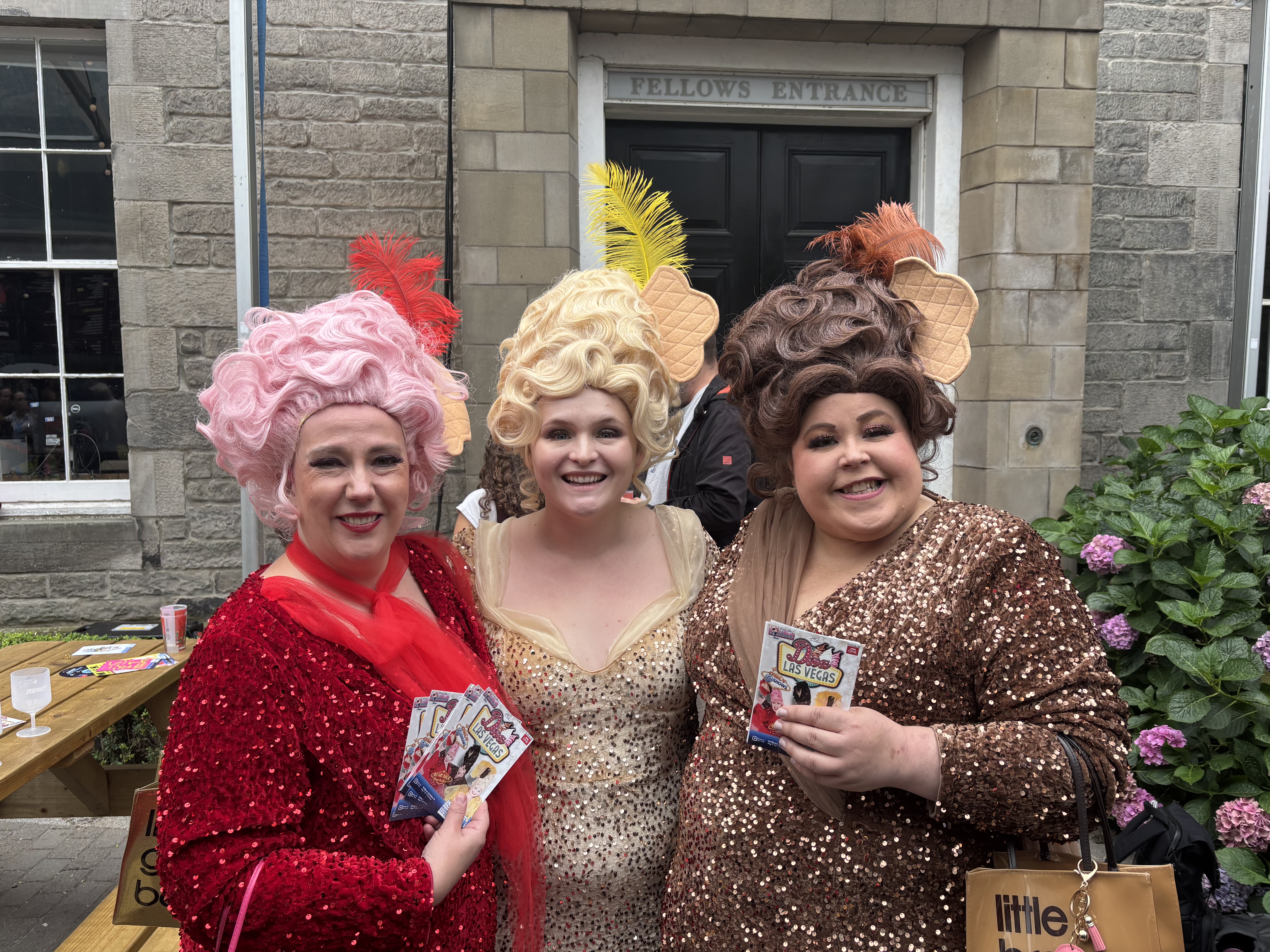
Some Fringe encounters are carefully scheduled weeks in advance; others arrive in a burst of sequins and charisma. At theSpace’s Meet the Press event, I met The Sundaes — the gloriously larger‑than‑life comedy harmony trio returning to the Fringe after an eight‑year absence with their new show, *Diva Las Vegas*. Even offstage, they radiate the kind of energy that makes you turn your head before you even realise you’re smiling.
Finalists on BBC One’s *All Together Now*, The Sundaes have built a reputation for powerhouse vocals, sharp comic timing and a celebratory performance style that blends cabaret, pop, musical theatre and unapologetic glamour. *Diva Las Vegas* draws inspiration from the icons who shaped the city’s legendary stages — Shania Twain, Tina Turner, Céline Dion, Diana Ross — artists known for big voices, big emotions and even bigger showmanship. The Sundaes take that lineage and twist it into something distinctly their own: mash‑ups, choreography, comedy, and arrangements that let all three performers shine.
What stands out immediately is how joyfully they inhabit their aesthetic. Their publicity material promises sequins, sparkle and spectacle, but in person they offer something more meaningful: a celebration of bodies, confidence and presence. The Sundaes have long been embraced as a body‑positive act — not because they make it a slogan, but because they embody it. Their performance style rejects the idea that glamour belongs only to certain shapes or sizes; instead, they reclaim diva culture as a space where everyone can be loud, visible and magnificent. It’s refreshing, funny and quietly radical.
Meeting performers in full promotional mode is one of the Fringe’s great pleasures. At Meet the Press, surrounded by flyers, microphones and the usual August chaos, The Sundaes were already in character — not performing, but radiating the same warmth and theatricality that defines their shows. That collision between everyday festival logistics and full‑blown showbusiness is part of what makes the Fringe such an enjoyable oddity: one moment you’re navigating a crowded room, the next you’re chatting with three singers dressed like they’re about to headline Caesars Palace.
Their pitch is gloriously old‑school entertainment: harmony, humour, glamour and personalities large enough to reach the back row of any venue. After eight years away from Edinburgh, they’re returning with confidence and a sense of occasion. As their flyer proudly declares, they are “bigger than ever” — and it’s clear they intend to live up to it.
On the strength of this encounter, *Diva Las Vegas* promises to be a joyful, high‑octane celebration of music, comedy and unapologetic self‑expression. The Sundaes aren’t planning to slip quietly back into the Fringe; they’re here to make noise.
Love’s Concordia Bar was a whirlwind of emotion. It was expressed not only through its compelling script but also through the dynamic dancing. The original songs left the audience captivated.
The performers were nothing short of mesmerizing, embodying their roles with a passion that resonated throughout the venue. Their acting prowess was matched by their physicality. They performed dance routines that were both intricate and expressive. These routines told stories within the story. The original songs were a breath of fresh air, weaving melodies and lyrics that perfectly complemented the narrative.
It’s worth noting that the cast was attractive, adding a layer of allure to the already steamy performance. The show was undeniably sexy, with a palpable chemistry between the actors that was impossible to ignore.
However, no show is without room for improvement. In my view, the script, while engaging, could benefit from being more concise. They should aim for a runtime of 50 minutes to an hour. It would tighten the narrative and keep the audience on the edge of their seats. The excitement will last from start to finish.
The venue, while intimate and fitting for the performance, could do with better ventilation. Comfort is key in keeping the audience focused on the performance, and this small change could make a significant difference.
The theme of the show delved into the darker aspects of love. It explored how love can sometimes feel like a trap. While thought-provoking, a character who embodies hope could offer a more balanced perspective. This character could also show the possibility of love’s liberation.
The narrator was a standout element of the show. They guided the audience through the narrative with a presence that was commanding. Developing this role further could enhance the connection between the performer and the audience. Perhaps more direct speech to the audience could make the experience even more immersive.
In general, increasing audience interaction could be a valuable addition to the show. Engaging with the audience can break the fourth wall. It can bring a unique energy to the performance. This creates moments that are both memorable and personal.
Love’s Concordia Bar is a bold and evocative production. It captures the complexities of love with grace and intensity. With a few tweaks, it has the potential to be not just a good show, but a great one. It’s a must-see for those who appreciate the art of theatre and the power of a well-told love story.
Fabulett 1933 is an extraordinary one-person musical that brilliantly brings to life a pivotal era in history through the eyes of the charismatic MC, Felix, masterfully portrayed by Michael Trauffer. Set against the backdrop of Berlin in 1933, a city teetering on the precipice of change, the show immerses its audience in the vibrant world of cabaret, a unique form of entertainment that effortlessly blends music, satire, comedy, and political commentary.
Michael Trauffer is compelling as Felix
At the heart of Fabulett 1933 is Felix, the magnetic MC of a gay cabaret club. As the story unfolds, we witness Felix’s struggle against the encroaching closure of his cherished venue and the ominous rise of fascism. The show deftly weaves together historical accuracy with original songs and performances that once fell under the Nazis’ label of “degenerate.” Trauffer’s performance captures the essence of the era, embodying the resilience and defiance that characterized those who dared to speak out.
Cabaret, a genre that reached its zenith in Berlin during the Weimar Republic (1919-1933), finds a poignant representation in Fabulett 1933. This unique form of artistic expression emerged as a powerful platform for social critique and artistic experimentation, flourishing within the vibrant heart of the city. It introduced audiences to a fusion of music, comedy, and political commentary, challenging societal norms and inciting thought-provoking discussions. Renowned figures such as Marlene Dietrich, Kurt Weill, Bertolt Brecht, and Max Reinhardt breathed life into this genre, pushing the boundaries of creative expression.
However, the looming shadow of the Nazi regime cast a sinister pall over this artistic revolution. With their oppressive tactics, the Nazis stifled cabaret, banning and censoring its performers and venues, effectively quashing a beacon of intellectual and artistic freedom.
Fabulett 1933 resonates powerfully through its masterful depiction of the Weimar Republic’s cabaret scene. Trauffer’s portrayal of Felix captures the essence of a complex character who confronts not only the closure of his club but also his own battle against intolerance. The show garnered well-deserved acclaim during its runs at London’s Canal Café Theatre and the Edinburgh Festival Fringe, receiving multiple 4-star reviews.
Critics have been effusive in their praise for Fabulett 1933, with descriptions such as “a captivating and moving performance that blends history, humor, and heartbreak” underscoring the show’s emotional depth. Another review aptly hails it as “an elegant slice of cabaret that transports us to the final days of one of Germany’s most vibrant eras,” invoking the nostalgia and vibrancy of the time. Perhaps most significantly, the show is heralded as “a powerful reminder of the importance of visibility and resistance in the face of oppression,” encapsulating the poignant message of Fabulett 1933.
One cannot discuss the show without acknowledging the rich historical context that serves as its backdrop. The Weimar Republic, a brief yet remarkable period of relative tolerance and cultural expression for gays, is illuminated through the lens of Felix’s experiences. This vibrant subculture emerged in Berlin, characterized by a proliferation of bars, clubs, magazines, organizations, and artists catering to the gay community. The influence of figures like Magnus Hirschfeld, founder of the Institute for Sexual Science, is palpable. Hirschfeld’s dedication to scientific and legal reforms, including the repeal of the infamous Paragraph 175, was a defining moment in the fight for LGBTQ+ rights.
Fabulett 1933 gracefully navigates the delicate balance between its serious subject matter and moments of levity. Humor surfaces through the witty banter exchanged between Felix and his pianist Hans, creating a dynamic that lightens the mood without diluting the show’s emotional impact.
Central to the performance are the songs that encapsulate the era’s spirit. Trauffer’s adept translation of iconic pieces like “Das Lila Lied” (The Lavender Song) and “Maskulinum-Femininum” showcases his talent in preserving the essence of the original lyrics. Additionally, Trauffer’s original compositions, notably “Your Cabaret Needs You” and “Invisible,” enhance the show’s emotional resonance, serving as a powerful testament to the enduring spirit of resistance.
In a world that often grapples with issues of freedom, identity, and acceptance, Fabulett 1933 stands as a poignant reminder of the struggles faced by those who dared to be different. Through Felix’s journey, the audience is urged to recognize the invaluable importance of diversity and resist the encroachment of oppression. This evocative and thought-provoking musical serves as a cautionary tale, encouraging us to remain vigilant against red flags and warning signs that threaten the very essence of human rights and freedom.
Fabulett 1933 is more than a show; it’s an immersive experience that transports us to a time when artistic expression and personal authenticity clashed with a world descending into darkness. Michael Trauffer’s remarkable performance, combined with the rich tapestry of historical nuances and unforgettable melodies, leaves an indelible mark on the hearts and minds of its audience.
24-29 August 2015
Time: 1715
Duration: 50 mins
Venue: SpaceTriplex
As we entered the theatre Jazz musicians played Caravan I had come to see Muse a fascinating telling of the story of Jean Ross, the inspiration for the character Sally Bowles in Cabaret. Sophie Juge plays Jean Ross who tells us her story through drama and music. The music is great including such classics as Mad About the Boy, Alabama Song and Love for Sale.
In Cabaret and ‘Goodbye to Berlin’, the book by Isherwood (who lodged in the same house in 30s Berlin) the story of ‘Sally Bowles’ ends abruptly. In real life Ross continued to have a series of lovers. In fact one lover, Eric Maschwitz, wrote These Foolish Things about Ross after the end of their affair. Ross was also a political journalist who reported from the front-lines in the Spanish Civil War and married Claud Cockburn who wrote for the Daily Worker (and also had a column in Private Eye for many years). She was a life-long Communist. Juge Performs the anti-fascist El Quinto Regimento to illustrate this part of the life of Ross.
This is a great story with a passionate, expressive and skilful performance from Juge. I highly recommend it. It is on at the Fringe till the 29th. Try and catch it!