Introduction
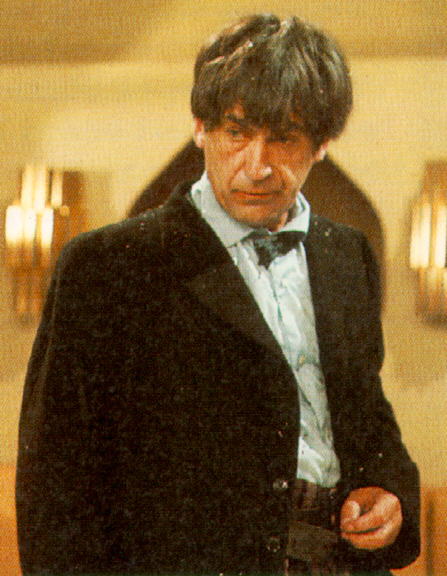
The ten-part original of The War Games, the last story of the Patrick Troughton/Second Doctor era, released in late 1969, has a special place in my heart. Although I have a hazy memory of William Hartnell’s First Doctor being accosted by Daleks on my family’s tiny, flickering black-and-white TV (I like to imagine this was in one of the ‘lost’ episodes, perhaps from the epic Dalek Masterplan), and I did watch Troughton’s Doctor regularly, as I know because I recall having an early existential crisis when the show was scheduled directly opposite another favourite, the Adam West-era Batman series on ITV in the Saturday tea-time post-football results slot, it is Troughton’s circling head before an unseen regeneration and temporary exile to modern-day Earth forced upon him by his ‘people’, the newly revealed Time Lords, which is my first clear Who memory.

The War Games: A Special Place in History
The changing of this ending for this newly colourised feature-length edit to incorporate his regeneration into Jon Pertwee’s dandyish action-hero Third Doctor was one of several concerns I had as I settled down to watch almost as soon as it was uploaded to the BBC iPlayer two days before Christmas.
In reality, Pertwee had not even been cast when The War Games ended, and at the time, though the seven-year-old me wouldn’t have been aware of this, it wasn’t a certainty that anyone would be cast to succeed Troughton. With radically fallen viewing figures compared to the peak of Dalek-mania in the mid-60s, the future of the show itself was in doubt.
Happily, Pertwee, who I still consider to be my Doctor, was cast and the series returned, and for the first time in glorious colour (and on film rather than the video, for that one story only) in the epic Spearhead From Space the following year, though, as for the majority of the British population, the era of colour television wouldn’t begin in the Green household for another two or three years yet.
Concerns About the New Colourised Version
Another concern was the precedent of last year’s Christmas ‘treat’, The Daleks in Colour. This had its good points. I thought the colourisation of this second-ever Who story from December 1964 worked well visually. The Dalek City on Scarrow, in particular, looked spectacular, with its weird angular construction revealing itself as if for the first time. But the edit, a reduction of a seven-part story of roughly twenty-five minutes each part down to a mere seventy-five minutes, was uneven, to say the least, and must have had many of those not familiar with the original scratching their heads as to how and why the action had suddenly switched from A to B. In that respect, it was vastly inferior to the non-canon but always in colour Peter Cushing movie of The Daleks, which was released in 1965 and was itself essentially a remake of the television serial, though with some crucial differences (like a fully human Doctor and a much younger Susan).
How much more difficult would it be to produce a coherent narrative out of the even longer War Games?
The Original vs. The New Edit
Like most fans, I’d also hated the replacement of the original, suitably eerie BBC Radiophonic soundtrack for The Daleks with a new musical score, which turned out to be so bombastic and overblown that it obscured parts of the dialogue. It was also woefully inappropriate in places. In one scene, the music was better suited to a sketch involving Benny Hill chasing bikini-clad lovelies around a field on ITV in the unenlightened 1970s than a classic vintage Science Fiction story.
I was therefore not best pleased that The War Games had also been provided with a new musical score by longtime modern Who composer Murray Gold.
Music and Soundtrack Changes
Again, the music was a trifle loud at times, but not to the extent of The Daleks in Colour, with the dialogue remaining audible at all times to my ears (though opinions differ on this), and Murray Gold incorporated many of the elements of Dudley Simpson’s (excellent) original score into his work for the new version.
Additions to the Story
There was also the matter of additions being made to the story to fit parts of the show’s canon that had not yet been thought of, the most glaring example in the new version of The Daleks being our favourite ‘pepper pots’ (as Pertwee, never a Dalek fan, derisively called them) blaring ‘Exterminate!’ at every available opportunity, a catchphrase, if such it could be called, they would not fully adopt for another two Dalek-based serials, until Series Two’s The Chase in 1965. (The word was used in the first Dalek story, but not as a prelude to offloading their weaponry).
The new effects had been decent enough, but the newly added Dalek voices most definitely weren’t, despite the involvement of go-to Dalek voice guy Nicholas Briggs.
The War Chief and The Master Debate
We then come to two main points of controversy, both of which occurred in the slower-paced, lore-heavy, and very enjoyable last quarter of the feature.
Firstly, for years, fans have debated the question of whether The War Chief was an earlier incarnation of the Doctor’s later chief nemesis The Master, who would not be introduced until two years later in season eight’s The Terror of the Autons, played by the late-great Roger Delgado. The consensus was that he was not, and though the issue has never been addressed on TV, where The War Chief has never re-appeared, the expanded Who media of novels, short stories, comics, and Big Finish Audio adventures (a world in which I’m little more than a sporadic dabbler) have seemed to confirm that he was indeed a separate character.
However, in The War Games in Colour strong hints are given that the War Chief is indeed an earlier incarnation of The Master. This is done subtly via Murray Gold’s adaptation of the score to include musical references associated with both Delgado’s Master and the excellent Sound of Drums theme he composed for use during the John Simms incarnation of the character in modern Who. In addition, as a further sonic clue, as The War Chief is killed about twenty minutes before the feature concludes, a little too easily for my liking, we hear the faintest beginnings of the sound that usually marks the commencement of a Time Lord regeneration process in the post-2005 show.
Initially, I was ambivalent about the issue. I would have been quite happy to have kept them as two separate characters, as I’d always assumed them to be, but I could also see the sense and appeal of establishing The War Chief as an earlier version of The Master, especially as the gap between the emergence of the two was relatively short, about two years in real-life Earth years.
Regeneration Scene Changes
we come to the regeneration of Second into Third, Troughton into Pertwee. One thing I most definitely didn’t like, and fandom is almost united as one non this, was the alteration of the scene when, after the conclusion of their summary trial of the Doctor on Gallifrey (which looks tremendous in the new version by the way, in the brief outdoor shots), where he was offered a degree of choice as to the form his new self would take post-regeneration. In the original, the Doctor was shown simple pencil drawings of possible faces which he rejected one by one as ‘Too fat!’ ‘Too thin!’ ‘Too Old!’ etc.
In this revised version, he is shown photographs of actual future modern Doctors, namely Capaldi’s Twelfth (‘Too old!’), Tennant’s Tenth (‘Too Thin!’) Matt Smith’s Eleventh (‘Too Young!’), and Whittaker’s Thirteenth (no comment, which could be seen as a silent commentary on how Troughton’s Doctor might have received the possibility of a sudden sex change, or indeed of how the idea of a female Doctor might have been perceived by fans of the show in 1969).
We lose ‘Too fat!’ from this scene completely, as ‘fat shaming’ is now deemed to be one of those things we all must oppose, though ‘thin shaming’, is apparently, fine.
I can see no reason other than to troll longstanding fans for the inclusion of the modern Doctors in this section, and it would stretch even the most psychedelically enhanced ‘Head-Canon’ to fathom how this even works ‘in-universe’, especially as they were shown in their full Doctor outfits. A much better idea, in my opinion, would have been to have Troughton’s Doctor reject photographs of actors who at one time or another were mooted to play the part, but who ended up not doing so, actors such as Ken Campbell, the best Doctor we never had, and whose audition was rejected as ‘too weird’, Michael Crawford (who was first choice for the 1996 TV Movie but was unwilling to commit to another possibly long-running role after many lengthy runs in Broadway musical productions, Brian Blessed, the recently sadly departed Tony Slattery (whose own audition for the TV Movie can be found online, along with Slattery squirming with embarrassment at his performance as he reviews it years later), Paul Daniels (Seriously. The fact that he was even considered is an indication of how low in the BBC’s estimation the show had sunk under the stewardship of chief-Who-hater Michael Grade by the 1980s), and Joanna Lumley (my choice at one time, and who did very briefly play the role, along with Rowan Atkinson and a host of others in the 1999 Steven Moffatt penned Children in Need short The Case of Fatal Death.)
Something along these lines would at least have been funny, though there would also have been nothing wrong with sticking with the original pencil drawings.
The regeneration itself was in line with the almost uniform format of the modern show. I hope a similar uniformity isn’t imposed on other classic-era transitions from one Doctor to another.
But for all that, it was quite nicely done, adapted from a fan creation by one Jacob Booth which had been knocking around on YouTube for a while. At least the BBC had the decency to credit and pay him.
It’s also worth mentioning that many of us breathed a sigh of relief that we at least got a straight Troughton to Pertwee transition. The worry had been that the opportunity may have been taken to shoe-horn The Fugitive Doctor, a hitherto unknown incarnation who emerged during the hated Chibnall/Whittaker era, who, although very well portrayed by actress Jo Martin, further muddied the waters of the show’s ever-looser canon by having no credible place to fit within the pantheon, into place between the two.
One objection to the notion of including a regeneration scene at all was that it would mess up the beloved idea of the mythical ‘Series 6B’. This is a series of stories, official and unofficial, mostly in the form of novels and audio, that take advantage of the lack of a physical regeneration at the end of the War Games, to imagine a series of adventures that Troughton’s Doctor undertook at the behest of the Time Lords before he takes on his new form in Series 7.
However, enough of a gap is left before Troughton is seen in the process of transformation, sitting on a chair in the Tardis before staggering out of the door at the start of Spearhead From Space, Pertwee’s debut in the role, for Series 6B to survive.
Final Thoughts on The War Games in Colour
And that really is it. Despite my criticisms and reservations and the understandable controversies the production has elicited, I did think The War Games in Colour was an excellent Christmas gift, well worth ninety minutes of your life, and perhaps the best thing Russell T Davis has yet given us since he once again took up the reigns as Overlord of his newly extended ‘Whoniverse’ (ugh!).
Conclusion
The War Games in Colour is available to watch on the BBC iPlayer (at least if you live in the UK) and presumably will continue to be so until we get a physical release, which is surprisingly not due until January 2026.
Recommended.
Anthony C Green, Jan’ 2025
Picture credit
By BBC – http://www.shillpages.com/dw/trougp03.jpg, Fair use, https://en.wikipedia.org/w/index.php?curid=1182131